USMNT
The No. 9 Timeline: A Historical Look at USMNT Strikers

Thomas Deschaine (@uskeeper on X and us_keeper on Instagram)
Each generation of soccer can be understood through overlapping eras, each one feeding into the next. Some produce deeper pools of talent, while others rely on a handful of standout players. In a recent piece, I looked back at past USMNT goalkeepers and their impact on World Cup teams. That led to a natural follow-up: a deeper dive into the history of USMNT strikers.
For this article, I’ve divided that history into three distinct eras, focusing strictly on past strikers rather than the current pool. I’ll wrap up, however, with some thoughts on where today’s active strikers fit into that broader timeline. For each era I will spotlight four strikers.
According to their media guide, the modern era of the USMNT begins with the 1990 World Cup cycle. While that framing makes some sense, it does gloss over some of the program’s more challenging decades. For the purposes of this, though, we’ll start there as well, especially considering that from 1974 to 1986, the USMNT averaged fewer than 20 matches per cycle and scored less than a goal per game across those four cycles.
Trailblazers: The Early Era of USMNT Strikers
The story of USMNT strikers stretches back nearly 40 years, to a time when goals were often hard to come by, but a handful of players still managed to leave a lasting impression. This was an era defined less by consistent production and more by moments, flashes of quality that stood out during a formative period for the program.
Players like Chris Sullivan, Eric Eichmann, Frank Klopas, and Roy Wegerle all played roles in at least one World Cup cycle and delivered important goals along the way. However, consistency and longevity at the international level proved elusive, reflecting the broader challenges the USMNT faced during this period.
Even so, these players helped lay the groundwork for future generations, establishing the foundation for what the striker position would eventually become.

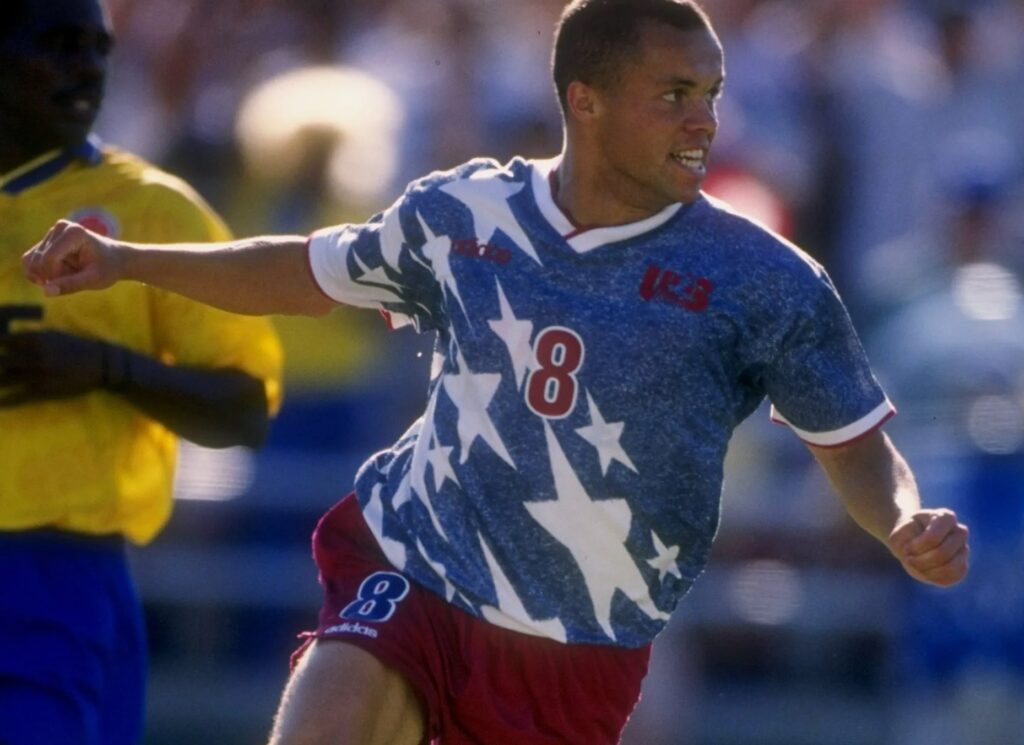
Bruce Murray (1985 – 1993)
85 Caps, 21 goals, 11 assists
A quick, opportunistic forward known for his movement and ability to capitalize on chances, Bruce Murray was the type of striker the USMNT hadn’t truly seen before. He filled that role throughout the 1990 cycle and into the lead-up to 1994, emerging as the team’s leading scorer during that stretch and helping guide the U.S. to its first World Cup appearance since 1950. At the 1990 World Cup, Murray contributed a goal and an assist, highlighting his impact on the international stage.
Despite his contributions, Murray was ultimately left off the 1994 World Cup squad, one of the final cuts as the program began to turn toward younger options and players competing in Europe at the time.
Eric Wynalda (1990 – 2000)
106 Caps, 34 goals, 17 assists
The premier striker of this era for the USMNT, Eric Wynalda featured in three consecutive World Cups. A dynamic and confident forward, he combined technical ability with a powerful shot, making him a constant goal threat and the focal point of the U.S. attack.
His iconic set-piece goal against Switzerland in the USMNT’s opening match of the 1994 FIFA World Cup remains one of the greatest in tournament history and stands among the best goals ever scored by the USMNT. Wynalda not only delivered in defining moments but also set the tone and standard for the strikers who followed.
Earnie Stewart (1990 – 2004)
101 Caps, 17 goals, 10 assists
Earnie Stewart was a key attacking figure for the USMNT throughout the 1990s and early 2000s, bringing a blend of technical quality, intelligence, and consistency to the squad. Comfortable as both a striker and a second forward, his versatility allowed him to influence matches in multiple ways while effectively linking midfield and attack.
While not a traditional No. 9, Stewart’s movement, awareness, and all-around contributions helped shape the evolution of the USMNT’s forward line during a critical period of growth for the program. He appeared in three World Cups—the 1994 FIFA World Cup, 1998 FIFA World Cup, and 2002 FIFA World Cup—and delivered one of the most iconic moments in U.S. soccer history, scoring the game-winning goal against heavily favored Colombia on home soil in 1994.
Second Generation USMNT Strikers (1996-2010)
The next era of USMNT strikers following the 1994 World Cup produced a tough, hard-nosed group. Several featured in one or more World Cup cycles, led by Josh Wolff, who made both the 2002 and 2006 squads.
Brian Ching and Eddie Johnson were also key figures, earning spots on the 2006 roster, with some arguing they were overlooked later in their careers. Other notable names from that period include Casey Coner, Ante Razov, and Taylor Twellman, players who all had opportunities with the USMNT, but whose form and timing didn’t quite align with World Cup selection. Twellman, in particular, still believes he should have been part of the 2006 squad.

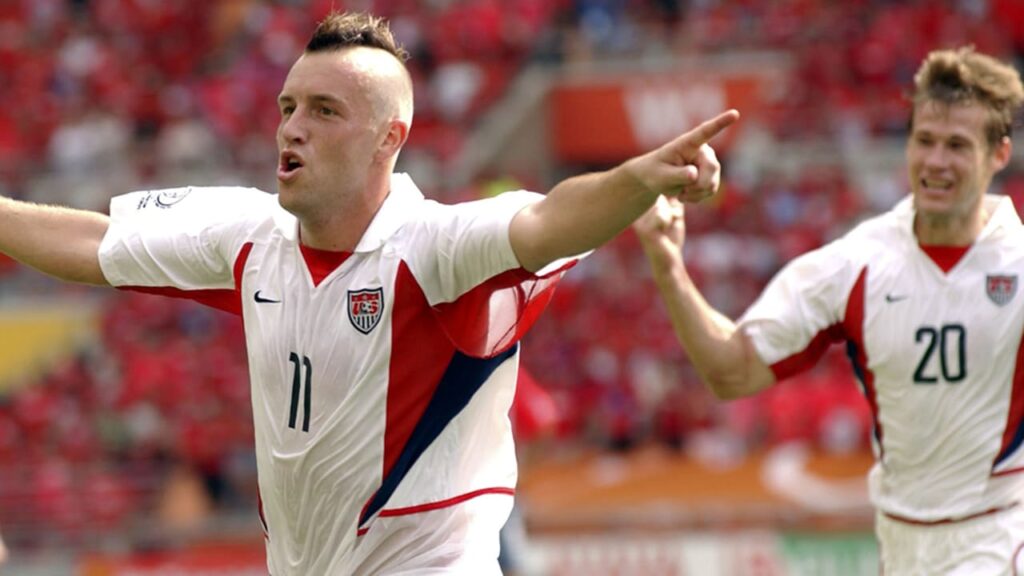
Joe-Max Moore (1992 – 2002)
100 Caps, 24 goals, 14 assists
This was always a bit of a sneaky one for me. Joe-Max Moore was a consistently reliable attacking option for the USMNT during this era, even if he didn’t always get the spotlight. Currently ranked seventh all-time in USMNT goals, Moore contributed across three World Cup cycles and remained a steady presence in the attack.
He’s also one of just five USMNT players to score four goals in a single match, a standout performance that came against El Salvador in 1993. Despite his overall production and longevity, however, Moore was never able to find the back of the net on the World Cup (1994, 1998 and 2002) stage.
Brian McBride (1993 – 2006)
95 Caps, 30 goals, 11 assists
A traditional No. 9, Brian McBride was physical, relentless, and dependable, with a dominant aerial presence in the biggest moments. He put everything on the line for the USMNT, scoring in multiple World Cups (1998 and 2002) and cementing himself as a fixture at the striker position.
One of his most iconic moments came at the 2006 World Cup, when he was elbowed in the face by Italy’s Daniele De Rossi, leaving him bloodied and in need of stitches, yet he still played the full 90 minutes.
Clint Mathis (1998 – 2005)
46 Caps, 12 goals, 9 assists
While Clint Mathis had a relatively brief run with the USMNT, his impact on the attacking position was undeniable. Often deployed as a second striker behind Brian McBride, Mathis was anything but traditional—he thrived as a free-roaming attacker capable of changing a match in an instant, highlighted by his ability to score spectacular long-range goals.
He played a key role for the U.S. at the 2002 FIFA World Cup, scoring a memorable goal against South Korea in the group stage and adding an assist, helping power the team’s historic run.
The Evolving Striker Pool (2009 – 2018)
The striker pool from this generation is an interesting mix, some players were only involved with the USMNT for brief stretches, while others carried over from the previous era and overlapped with this group.
Strikers like Edson Buddle and Hercules Gomez, both part of the 2010 World Cup roster, had limited opportunities and production at the international level. Their inclusion was shaped in part by circumstance, as Charlie Davies’ recovery from his car accident less than a year before the tournament ultimately ruled him out of contention.
Looking ahead to 2014, Aron Jóhannsson and Chris Wondolowski earned World Cup roster spots but struggled to make a lasting impact in the biggest matches against top-tier opponents, which limited their long-term roles with the national team.
Players like Jordan Morris, Jesús Ferreira, and Gyasi Zardes emerged and saw increased opportunities following the failure to qualify for the 2018 World Cup. It’s easy to imagine that at least some of that younger group could have factored into the roster had the U.S. made it to Russia.
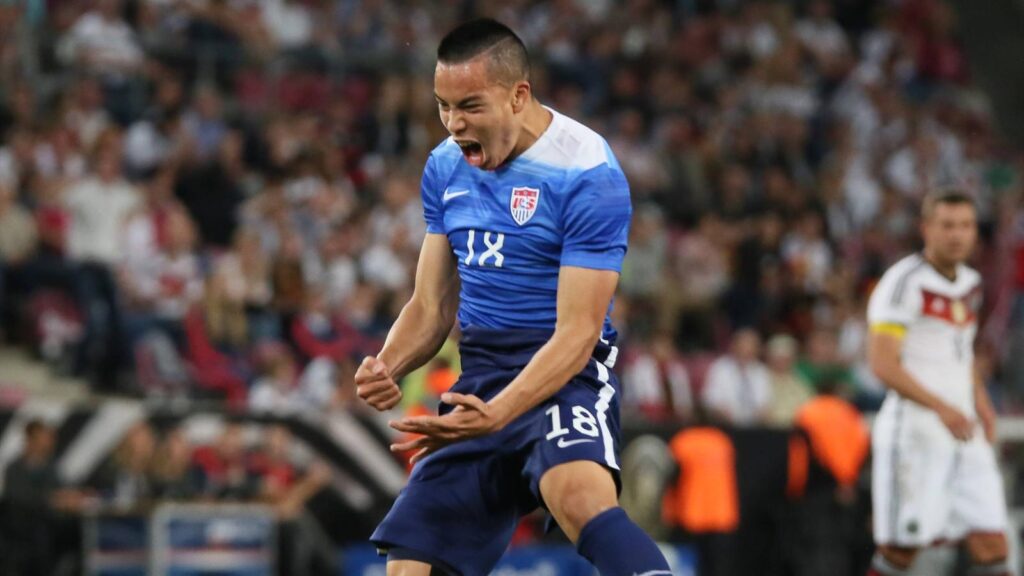
Clint Dempsey (2004 – 2017)
141 Caps, 57 goals, 19 assists
Clint Dempsey delivered some of the most iconic striker moments in USMNT history, big goals, clutch performances, and a relentless ability to show up when it mattered most. While he wasn’t a traditional target striker, his movement, instincts, and technical ability made him one of the most dangerous attacking players the U.S. has ever had.
He scored against top-tier opponents like Spain and Brazil at the 2009 Confederations Cup, found the net against England at the 2010 World Cup to help secure a crucial draw, and famously opened the scoring just seconds into the 2014 World Cup. He also delivered in the 2016 Copa América, with key goals against Ecuador in the quarterfinal and Paraguay in the group stage.
Dempsey wasn’t just a scorer, he was a moment-maker. Whether it was a scrappy finish, a composed strike, or stepping up in the biggest matches, he consistently delivered when the U.S. needed him most.
Jozy Altidore (2007 – 2019)
115 Caps, 42 goals, 14 assists
Jozy Altidore had a unique USMNT career, less about highlight-reel volume and more about physical presence, hold-up play, and stepping up in key moments. At his best, he was the focal point of the attack and a difference-maker. Jozy’s work ethic seemed to impact later stages of his club and USMNT career and impacted him becoming the all-time leading scorer in USMNT history.
Bobby Wood (2013 – 2018)
43 Caps, 13 goals, 3 assists
If it weren’t for Jürgen Klinsmann’s support after Bobby Wood secured a new club in Germany, it’s unclear whether his international career would have continued. While his peak was relatively brief at both club and national level, Wood made his mark with clutch moments, most memorably scoring game-winning goals in back-to-back 2015 friendlies: a 4–3 comeback victory over the Netherlands and a 2–1 win against Germany.
The Next Generation: Assessing the Future of USMNT Strikers
The current USMNT striker pool remains very unsettled. At the moment, Ricardo Pepi is the only regular forward to reach double-digit goals, with 13. He’s followed by Folarin Balogun with eight and Haji Wright with seven. Other notable names in the mix include Josh Sargent and Patrick Agyemang, each of whom has contributed five goals at the international level. However, Agyemang suffered an Achilles injury and has been ruled out of the World Cup, a significant setback given his recent form. For the USMNT to be successful at the 2026 FIFA World Cup their strikers will be a key role and contributing to the teams’ goals scored.

From a club perspective at the time of the article, Balogun is in excellent form, and the hope is that continues through the 2026 FIFA World Cup. At this point, it feels clear that Balogun and Pepi have established themselves as the top two striker options. The bigger question, though, is who else will step up to provide the depth and quality needed to sustain the position in this cycle and beyond.