
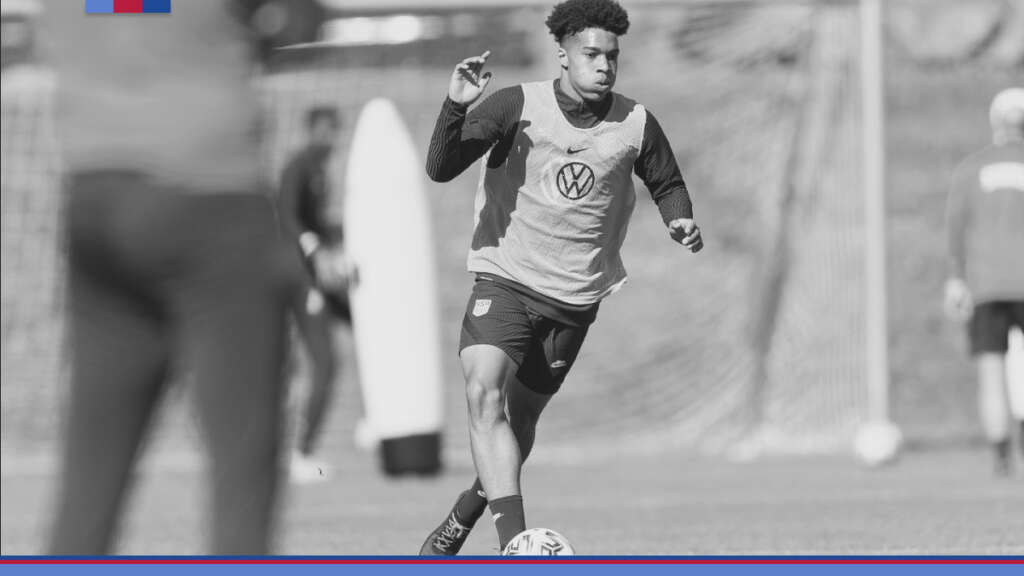
USMNT
USYNT U20 Report – MARCH 2022
Overview
The U-20 USYNT are preparing for a massive summer where they will play in a Concacaf competition to qualify for the 2023 U20 World Cup and the 2024 Olympics which will take place from June 18 – July 3, 2022, in San Pedro Sula and Tegucigalpa, Honduras. Per Concacaf:
The competition will kick off the third week of June with a Group Stage between the top ranked 16 teams (according to the Concacaf Men’s U-20 Ranking). After Group Stage play (June 18-23) the top three teams in each of the groups will advance to the Round of 16, joining the four CMU20C Qualifiers winners (qualifiers between the lowest ranked nations took place in November 2021, results are available here).
The 16 team Knockout Stage will begin with the Round of 16 (June 25-26), followed by the Quarterfinals (June 29), Semifinals (July 1), and Final (July 3). Further details on the scheduling will be announced after the draw.
All Knockout Stage matches will be played in a single match elimination format, with the semifinalist (four teams) qualifying to the FIFA Men’s U-20 World Cup Indonesia 2023 and the finalists (two teams) to the 2024 Paris Summer Olympic Games.
The draw for the Group Stage of the 2022 CMU20C will take place March 3 (11:00 am ET), at the Concacaf headquarters in Miami, FL. Fans will be able to follow the event via the Confederation’s Official App, Website, Facebook page, and YouTube channel.
For the draw, the top four ranked teams, USA, Mexico, Panama, and Honduras have been seeded into Groups E, F, G, and H respectively. The remaining 12 nations will be split into 3 pots according to their ranking as follows (listed in ranking order per pot and the highest ranked teams in Pot 1):
Pot 1: Costa Rica, El Salvador, Cuba, and Haiti
Pot 2: Canada, Trinidad & Tobago, Guatemala, and Jamaica
Pot 3: Antigua & Barbuda, Suriname, Saint Kitts and Nevis, and Aruba
Teams will be drawn and placed into Groups E, F, G, and H in sequential order, with no more than one team of each Pot per group.
Group E: United States, E2, E3, and E4
Group F: Mexico, F2, F3, and F4
Group G: Panama, G2, G3, and G4
Group H: Honduras, H2, H3, and H4
This team is and will be made up of players born in the year 2003 or later. What is slightly confusing about this dual qualification, is that the 2024 Olympic team will ultimately be open to players born in 2001 or later, yet it’s the 2003s that are qualifying for it.
The team will be led by Mikey Varas who was appointed on November 5th, 2021 right before the Revelations Cup, a set of three matches against Brazil, Mexico and Colombia. Mikey was most recently an assistant at FC Dallas under now USMNT assistant Luchi Gonzalez. FC Dallas is one of the most prolific academies in the US and has been the biggest source of talent for the USMNT and European clubs.
Upcoming Camps
According to USSF, the next camp will be held from March 21 – March 30, during the same International Window that the USMNT will be playing their last WCQ matches. It’s rumored that the U20s will play in a set of friendlies down in Argentina against some very competitive teams.
The USSF has also communicated that there will be a camp from April 22 – May 1, likely the last time this group will get together before the summer. Mikey Varas will have two more camps to bring in different players and settle on a final evaluation ahead of the Honduras tournament.
Player Pool Overview
This team will be predominantly populated by players in the 2003 and 2004 class, though there have been a few 2005s that have participated in recent camps. The 2003 class is widely considered to be one of the strongest that the US has ever produced, with both high end talent and depth. The 2004 group is less acclaimed. They were more heavily impacted by the lack of games during the pandemic and the 2004s have been less prolific in receiving first team deals domestically. There are some very intriguing 2004 prospects that are currently playing within European academies. The challenge with European based players is that youth camps are not camps that clubs are required to release players for, so it can be more difficult to get those players into camps, however the competitive matches this summer are occurring during the European off-season.
Within this article I will detail who has been called into the last two camps, who I think should be in the mix for the summer tournament, and who I would like to see in the March camp, assuming a 26-person squad.
From what we have seen from Mikey Varas, it looks like he will prioritize a similar 4-3-3 formation as the USMNT. Continuity throughout the US system will allow players to integrate and impact more quickly as they move through the ranks. The positions of strength for this age group includes: goalkeepers, left-backs, central-mids (8s) and wingers. The weaknesses of this group include center-backs, defensive-mids (6s) and strikers (9s).
Positional Breakdown
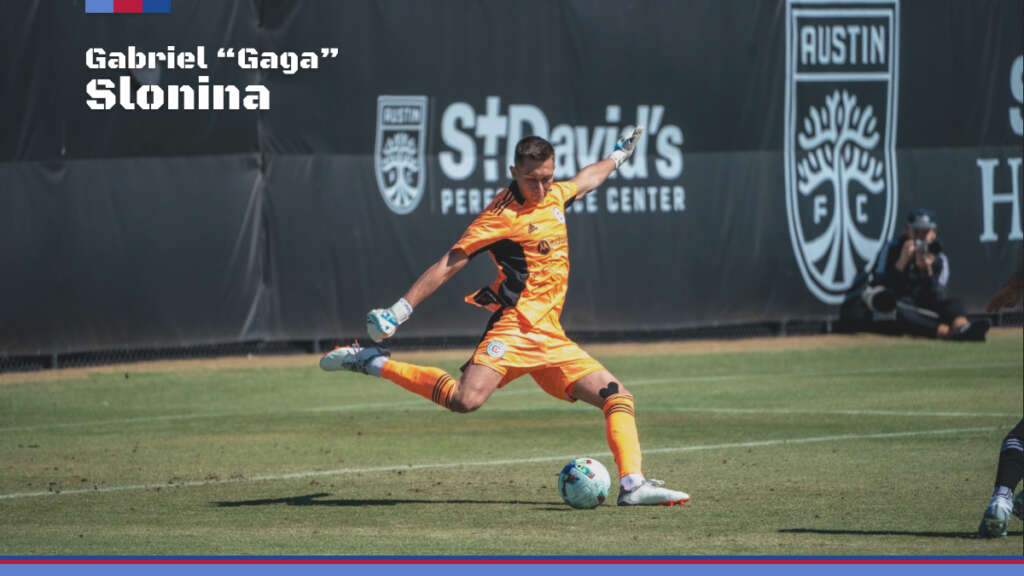
Goalkeepers
This is a really loaded group. The 2004s have the potential to be the greatest class of goalkeepers across the board in US history. There is that much talent. It’s early, so anything can happen. Gaga Slonina is the headliner, but there are many very good analysts that believe Jeff Dewsnup and Chris Brady are just as talented, if not more talented. What a luxury! Unfortunately, only one can play at a time and given Gaga’s recent rise and the fact he’ll be starting week in and week out for Chicago, he’s the likely starter.
The backup spot is completely up for grabs. Neither Dewsnup and Brady have been called into a recent camp, but I think that’s more because of the clubs than US preference. I suspect Dewsnup will be the eventual #2 so that if Gaga has to miss time with Chicago, Brady is there to play in his absence. We shouldn’t count out Alex Borto or Antonio Carrera either. Borto impressed in the November camp and Carrera’s recent camp performance boosted his stock in Feb, with two clean sheets in scrimmages against MLS clubs. Carrera recently signed his homegrown deal with FC Dallas.
Who has been called into last two camps: Gaga Slonina (Nov ‘21), Alex Borto (Nov ‘21), Antonio Carrera (Feb ‘22), KyMani Dada (Feb ‘22), Anthony Ramos (Feb ‘22)
My March call-ups: Jeff Dewsnup, Real Salt Lake City (2004), Chris Brady, Chicago Fire (2004), Antonio Carrera, FC Dallas (2004)
In my pool for the summer tournament: Gaga Slonina, Chicago Fire (2004), Alex Borto, Fulhum U18 (2003), Jeff Dewsnup, Real Salt Lake City (2004), Chris Brady, Chicago Fire (2004), Antonio Carrera, FC Dallas (2004)

Left-Backs
Left-backs are another position of strength, something US soccer fans haven’t heard, maybe ever. For my March call-ups I am assuming that Jonathan Gomez will be able to leave Real Sociedad and he will prioritize the American side over the Mexican side, but there is a high probability that JoGo will stay in Spain for this camp. In a recent interview, it sounded like JoGo was planning to prioritize the American U20 camp over Mexico when the next opportunity arises. If true, he is the overwhelming favorite to start, which will allow Kevin Paredes to play higher up the pitch on the wing.
The backup position is more competitive. My favorite to win the position is Caleb Wiley from Atlanta. He has been in the last two camps and recently signed his homegrown deal with Atlanta where he’ll be the primary backup to Andrew Gutman and the future of that position. Noah Allen has also come on strong for Inter Miami and he is likely pushing Caleb for that spot. I am a fan of both of their games and would like to see them both in camp to continue to compete for the LB2 spot.
Who has been called into last two camps: Caleb Wiley (Nov ‘21, Feb ‘22), Jacob Greene (Nov ‘21), Noah Allen (Feb ‘22)
My March call-ups: Jonathan Gomez, Real Sociedad B (2003), Caleb Wiley, Atlanta United (2004), Noah Allen, Inter Miami II (2004)
In my pool for the summer tournament: Jacob Greene, DC United (2003), Anton Sorenson, Philadelphia Union (2003), Tristan Viviani, San Jose Earthquakes (2004)

Right-Backs
The right-back and center-back depth chart will be impacted by where Mikey Varas wants to play Justin Che. He is probably this group’s best right-back and center-back so it will come down to what role will deliver the most positive impact to the team. I am electing to start him at right-back where is stronger right now and it is also where he is playing for Hoffenheim. Justin gives Mikey flexibility in how he wants to construct the squad and how they can play.
At the moment, my preferred backup is Mauricio Cuevas. He has been this age group’s primary RB for a while, but has been without a club until recently signing with Club Brugge’s reserve team. Still, he is one of the most talented players on this team and was called into the last camp. We’ll see if he gets called back in March. I’d love to see some in-game action and find out how rusty he is.
There are options behind Cuevas if he needs more time to regain form. My sleeper pick here is Alex Freeman, a very toolsy and athletic player that has come on strong over the last year or two. He was recently signed to a homegrown deal and he will likely end up being one of the top 04s.
For March, I want to learn more about the depth of this group, so I’d love to get a first look at Alex Freeman and Devan Tanton to have a full suite of information on this right-back position.
Who has been called into last two camps: Justin Che (Nov ‘21), Kayden Pierre (Nov ‘21), Mauricio Cuevas (Feb ‘22), Michael Halliday (Feb ‘22)
My March call-ups: Alex Freeman, Orlando City (2004), Devan Tanton, Fulham U18 (2004)
In my pool for the summer tournament: Justin Che, Hoffenheim (2003), Mauricio Cuevas, Club NXT (2003), Michael Halliday, Orlando City (2003), Alex Freeman, Orlando City (2004), Devan Tanton, Fulham U18 (2004), Kayden Pierre, Sporting KC (2003)

Center-Backs
This group was one of the glaring weaknesses of that Revelations Cup back in November, granted the team had almost no preparation time beforehand. In February, the group appeared to have improved based on the fact that they had two clean sheets in friendlies against MLS clubs.
The big question here is if Tony Leone is still open to the US project or if he’s fully committed to El Tri. I’ve heard that he is still open, but he’s only joined Mexico camps as of late. This might be the last camp before qualification, so maybe we can convince him to give it a shot? If not, remember that Justin Che can play here and Markus Ferkranus, Thomas Williams and Nigel Prince are also viable options.
Kobi Henry is a big and athletic prospect that seems to be very well thought of within the US ranks and a player who really caught my eye at the Revelations Cup. He was one of the U20s invited to the Senior December camp. He also recently went on a trial in France with Ligue 1 side, Reims, and it’s rumored that he will transfer there once he turns 18 in April.
Jalen Neal is a prospect I am not as high on as some others I respect. I need to see more of him, but it seems like he will be one of the preferred options. The last CB I have in my group is the very skillful Brandan Craig. Brandan is the best passer of this group and has added some much needed strength. We’ll see if he breaks through with the Union this year. He can also play defensive midfield which gives Mikey more flexibility. Brandan might end up being the best defensive midfield option this group has.
Thomas Williams, Marcus Ferkranus and Nigel Prince all fit the mold of big, strong and athletic center-backs that can dominate in the air, but are still developing the more technical sides of their game. They are all high upside players that have shown a lot of growth in the last couple of years.
A few other names to keep an eye on are Alejandro Cano, who was recently called into an El Salvador U20 camp. Hugo is recruiting Salvadoran-Americans hard. Anrie Chase is a really interesting name. He currently plays in Japan but is rumored to be moving to Eintracht Frankfurt when he turns 18. He has only played for Japanese youth teams, but it would be great to get him involved in an upcoming camp. Casey Walls really struggled in the Revelations Cup, but he’s skillful and it’s too early to remove him from the pool completely.
Who has been called into last two camps: Kobi Henry (Nov ‘21, Feb ‘22), Jalen Neal (Nov ‘21), Casey Walls (Nov ‘21), Marcus Ferkranus (Feb ‘22), Thomas Williams (Feb ‘22), Brandan Craig (Feb ‘22)
My March call-ups: Tony Leone, LAFC (2004), Kobi Henry, Orange County (2004), Jalen Neal, LA Galaxy (2003), Nigel Prince, Atlanta United (2004), Alejandro Cano, San Jose Earthquakes (2004)
In my pool for the summer tournament: Marcus Ferkranus, LA Galaxy (2003), Thomas Williams, Orlando City (2004), Nigel Prince, Atlanta United (2004), Anrie Chase, Eintracht Frankfurt in March (2004), Alejandro Cano, San Jose Earthquakes (2004), Casey Walls, San Jose Earthquakes (2003)
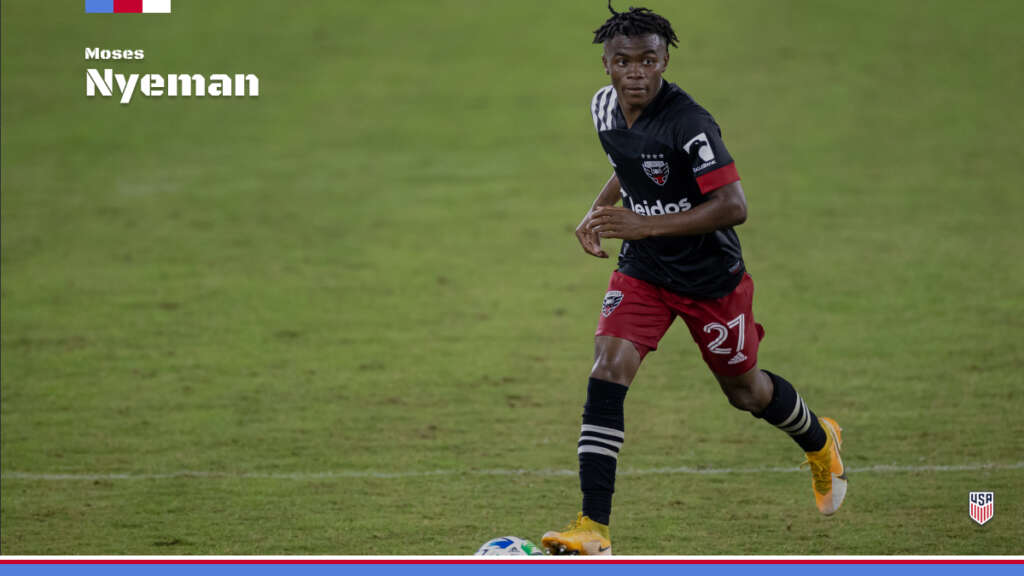
Defensive Midfielders
The defensive midfield position is another where there isn’t a clear starter. There are a few different options that have strengths and glaring weaknesses. From my perspective there are three routes Mikey can go:
Route 1, play the best three midfielders possible, in which case, I would argue that playing Moses Nyeman as a defensive midfielder would be the best option. He’s not a true 6, but he is talented enough to do the job and be more effective than the other true 6 options.
Option 2 is a more technical, ball-controlling 6 like Danny Leyva or Brandan Craig. Danny would improve offensive build-up and switching play, but he’s a big defensive liability.
Option 3 is prioritizing defense and the ability to mitigate danger, in which case Daniel Edelman is the best option. The reality is that all three of these players will likely be on the qualification roster and Mikey will use them all based on the opponent.
For the March camp, I would call in Moses Nyeman who hasn’t yet been in a U20 camp due to injuries and MLS preseason, but he’s sure to be a core member of this team. I would also call back Danny Leyva, if healthy, and I would love to get a look at Atlanta United DM/CB, Efrain Morales, who has a similar skill set as Brandan Craig.
Who has been called into last two camps: Daniel Edelman (Nov ‘21, Feb ‘22), Danny Leyva (Nov ‘21), Jeremy Garay (Nov ‘21), Jayvin Van Deventer, KC Academy (Feb ‘22)
My March call-ups:
Moses Nyeman, DC United (2003), Danny Leyva, Seattle Sounders (2003), Efraín Morales, Atlanta United (2004)
In my pool for the summer tournament: Moses Nyeman, DC United (2003), Daniel Edelman, NYRB (2003), Danny Leyva, Seattle Sounders (2003), Brandan Craig, Philadelphia Union (2004), Efraín Morales, Atlanta United (2004)
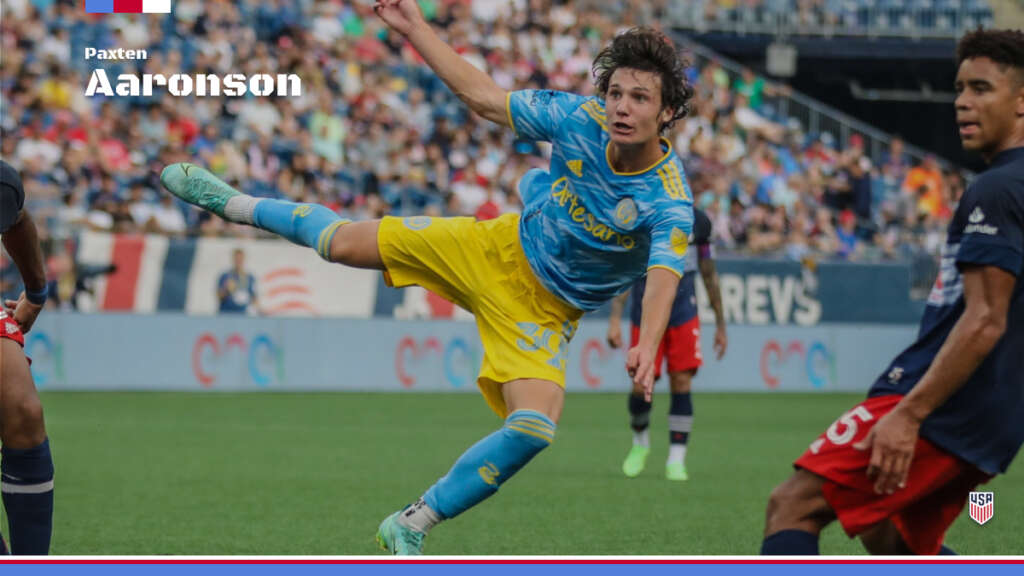
Central Midfielders
As we’ve learned from the USMNT, the dual 8s are a critical component of the US 4-3-3 system. Good news, we have some really strong options within this position group. As mentioned before, Moses Nyeman profiles better here, but I’m sticking him with a weaker 6 group, but he certainly will see time here.
Paxten Aaronson and Quinn Sullivan are locks for this roster. Both are high level prospects who are on the path to having big international futures. Paxten is more of a 10, but I think he can comfortably play here or on the wing depending on what Mikey needs in a given game/situation.
We’ve yet to see Alejandro Alvarado with the U20s and it’s unclear if Mikey rates him or if he hasn’t been available for release from Vizela. Alejandro is a former LA Galaxy academy product who has consistently been selected to the first team matchday squad with Portuguese side Vizela. Alejandro is a Mexican-American dual national who is highly technical and would add a really nice skill set to this midfield.
Another player I would love to see in camp is Kevin Bright who recently transferred from AC Milan’s academy to Cremonese’s academy. He’s a big and athletic midfielder with some very interesting tools. I’d love to see him integrated into the project.
Another player I would call in to camp in March is Zach Booth who recently signed his first professional contract with Leicester City in the Premier League. Zach, little brother of Taylor is just as talented and is playing well in England, recently coming off of a long injury.
Obed Vargas is 2005 and a fast riser. He recently debuted for Seattle in the Concacaf Champions League and was very impressive.
Jack McGlynn is another well known name, another Philadelphia Union player. I don’t love how his skill set fits how the US will want to play and how his skill set fits what we need from the 8s. Jack is a very technical player, but he’s a poor athlete that struggles to press, close down and track back defensively.
Who has been called into last two camps: Paxten Aaronson (Nov ‘21, Feb ‘22), Quinn Sullivan (Nov ‘21, Feb ‘22), Jack McGlynn (Nov ‘21, Feb ‘22), Obed Vargas (Feb ‘22), Rokas Pukstas (Nov ‘21), Javier Casas (Feb ‘22)
My March call-ups: Paxten Aaronson, Philadelphia Union (2003), Quinn Sullivan, Philadelphia Union (2004), Alejandro Alvarado Jr, Vizela (2003), Zach Booth, Leicester City U18 (2004), Kevin Bright, Cremonese U19 (2003)
In my pool for the summer tournament: Paxten Aaronson, Philadelphia Union (2003), Quinn Sullivan, Philadelphia Union (2004), Jack McGlynn, Philadelphia Union (2003), Obed Vargas, Seattle (2005), Alejandro Alvarado Jr, Vizela (2003), Zach Booth, Leicester City U18 (2004), Kevin Bright, Cremonese U19 (2003), Rokas Pukstas, Split U19 (2004), Evan Rotundo, Schalke U19 (2004)
Wingers
The winger group is another position of strength, though the top two players here aren’t necessarily true wingers. Kevin Paredes has played mostly as a wing-back, a position that isn’t used frequently within the US system. He can play as a LB, LW and RW and I project that with JoGo at LB, Mikey will move Kevin up the field to LW. Kevin is among the most talented players in this pool. He has yet to join this group because of injuries and his transfer to Wolfsburg, but I’d expect him there in March if Wolfsburg is cool with it and I definitely expect him with the team this summer.
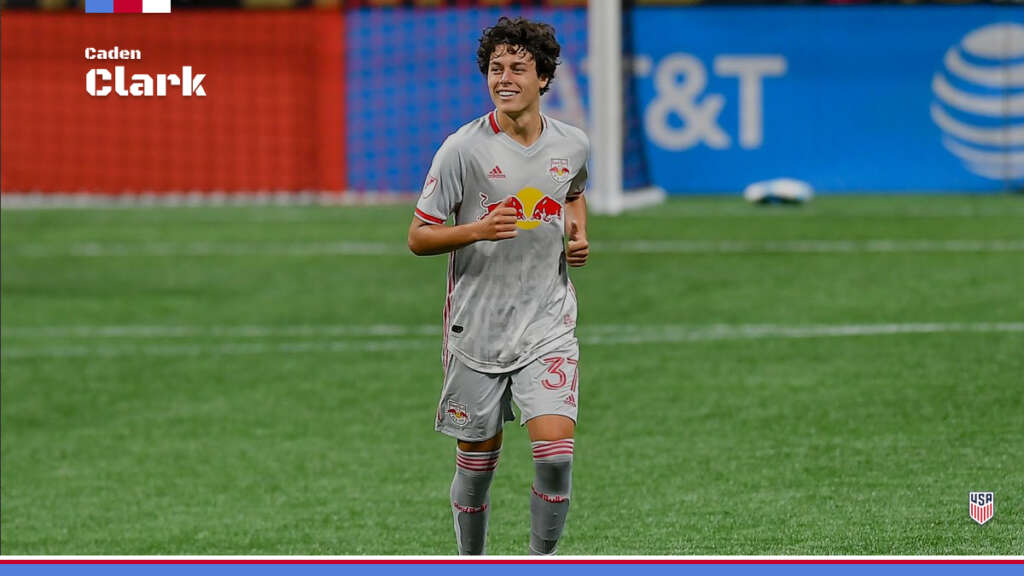
Caden Clark is another one of the top 5 talents in this group. He is a 10 who can play as an 8 or on the wing and he’ll probably play both of those positions for this team, similarly to Paxten Aaronson. Caden confirmed in an interview with Tactical Manager that he has been playing on the wing for the U20s, so that is why I have him here.
A name that may not be familiar to everyone that I really want to see in the next camp is Luca Koleosho. He plays for Espanyol’s U19 and has spent some time training with their first team. He’s a very athletic and talented winger that is also being pursued by Canada. He was invited to both camps in February and was not able to join the US camp due to club conflicts and was set to join the Canadian camp before it was canceled. It seems that we will have a competition for Luca so we need to get him into camp as soon as we can.
There are two very talented 2005s on my March squad. Bora Aydinlik is a Turkish-American who has yet to play in our setup, but he has been training with the Fenerbahce first team and was on the bench in their last Europa Conference League match. He’s clearly very well thought of and rising quickly. The other is Kristian Fletcher who is fast a rising prospect. He has trialed for Manchester United, Bayern Munich and Borussia Dortmund and is rumored to be heading to BVB, pending passport issues. He’s a very athletic winger who was in the last camp and played as a striker due to the lack of options there.
I didn’t elect to bring Dante Sealy who has been in both camps and will likely make the summer team, but I’d like to use the time in March to experiment with players we haven’t seen yet.
The depth at this position is really strong. Players like Gutierrez, Luna, Oliva and Bajraktarevic are all great options. Perez and Torres are on this list, but they seem committed to Mexico.
Who has been called into last two camps: Caden Clark (Nov ‘21, Feb ‘22), Dante Sealy (Nov ‘21, Feb ‘22), Brian Gutiérrez (Nov ‘21, Feb ‘22), Diego Luna (Nov ‘21, Feb ‘22), Esmir Bajraktarevic (Feb ‘22)
My March call-ups: Kevin Paredes, Wolfsburg (2003), Caden Clark, NYRB (2003), Luca Koleosho, Espanyol U19 (2004), Bora Aydinlik, Fenerbahce U19, Kristian Fletcher, Bethesda SC (2005)
In my pool for the summer tournament: Kevin Paredes, Wolfsburg (2003), Caden Clark, NYRB (2003), Dante Sealy, Jong PSV (2003), Luca Koleosho, Espanyol U19 (2004), Kristian Fletcher, Bethesda SC (2005), Brian Gutiérrez, Chicago Fire (2003), Diego Luna, El Paso Locomotive (2003), Jonathan Perez, LA Galaxy (2003), Yaya Toure, Colorado Rapids (2004), Federico Oliva, Atletico Madrid U18 (2004), Christian Torres, LAFC (2004), Esmir Bajraktarevic, Revolution II (2005)

Strikers
Much like the senior team, the striker position is a bit of a quagmire. Ricardo Pepi would be the obvious choice, but he’ll likely be playing with the senior team. Could he be an option this summer? That would be very intriguing.
For now, I am playing Cade Cowell here. It’s not his best position, but like Nyeman at the 6, he’s a lesser of evils. Cade could be a dynamic front man in the press and lethal as a vertical threat in the counterpress. He also has a nose for goals.
Sanogo has been at the last two camps and he profiles more to how Cowell would play the 9 position. Neither are target strikers, they are both guys who are more effective playing in behind a backline. As mentioned before, Fletcher played there last camp, out of position. Bohui also played there last camp, out of position, he’s more of a winger.
It would be really nice to find a target striker, which is why I would like to give Darren Yapi a try. A big and physical 9 from Colorado.
Who has been called into last two camps: Cade Cowell (Nov ‘21), Malick Sanogo (Nov ‘21, Feb ‘22), Patrick Bohui (Feb ‘22), Kristian Fletcher (Feb ‘22)
My March call-ups: Cade Cowell, San Jose Earthquakes (2003), Darren Yapi, Colorado Rapids (2004)
In my pool for the summer tournament: Ricardo Pepi, Augsburg (2003), Cade Cowell, San Jose Earthquakes (2003), Malick Sanogo, Union Berlin U19 (2004), Kristian Fletcher, Bethesda (2005), Patrick Bohui, Vejle Boldklub U19 (2003), Dzanan Mehicevic, Frankfurt U19 (2003), Tega Ikoba, Portland Timbers (2003), Darren Yapi, Colorado Rapids (2004), Javon Hendricks, Greuther Fürth U19 (2004)

USMNT
The No. 9 Timeline: A Historical Look at USMNT Strikers

Thomas Deschaine (@uskeeper on X and us_keeper on Instagram)
Each generation of soccer can be understood through overlapping eras, each one feeding into the next. Some produce deeper pools of talent, while others rely on a handful of standout players. In a recent piece, I looked back at past USMNT goalkeepers and their impact on World Cup teams. That led to a natural follow-up: a deeper dive into the history of USMNT strikers.
For this article, I’ve divided that history into three distinct eras, focusing strictly on past strikers rather than the current pool. I’ll wrap up, however, with some thoughts on where today’s active strikers fit into that broader timeline. For each era I will spotlight four strikers.
According to their media guide, the modern era of the USMNT begins with the 1990 World Cup cycle. While that framing makes some sense, it does gloss over some of the program’s more challenging decades. For the purposes of this, though, we’ll start there as well, especially considering that from 1974 to 1986, the USMNT averaged fewer than 20 matches per cycle and scored less than a goal per game across those four cycles.
Trailblazers: The Early Era of USMNT Strikers
The story of USMNT strikers stretches back nearly 40 years, to a time when goals were often hard to come by, but a handful of players still managed to leave a lasting impression. This was an era defined less by consistent production and more by moments, flashes of quality that stood out during a formative period for the program.
Players like Chris Sullivan, Eric Eichmann, Frank Klopas, and Roy Wegerle all played roles in at least one World Cup cycle and delivered important goals along the way. However, consistency and longevity at the international level proved elusive, reflecting the broader challenges the USMNT faced during this period.
Even so, these players helped lay the groundwork for future generations, establishing the foundation for what the striker position would eventually become.
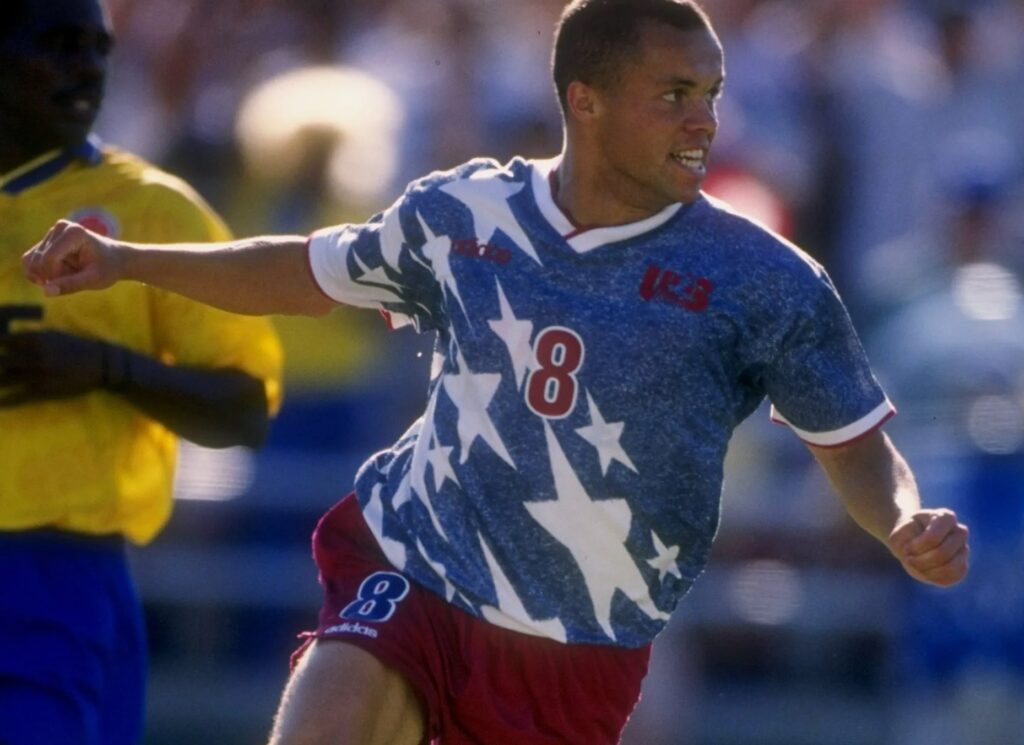
Bruce Murray (1985 – 1993)
85 Caps, 21 goals, 11 assists
A quick, opportunistic forward known for his movement and ability to capitalize on chances, Bruce Murray was the type of striker the USMNT hadn’t truly seen before. He filled that role throughout the 1990 cycle and into the lead-up to 1994, emerging as the team’s leading scorer during that stretch and helping guide the U.S. to its first World Cup appearance since 1950. At the 1990 World Cup, Murray contributed a goal and an assist, highlighting his impact on the international stage.
Despite his contributions, Murray was ultimately left off the 1994 World Cup squad, one of the final cuts as the program began to turn toward younger options and players competing in Europe at the time.
Eric Wynalda (1990 – 2000)
106 Caps, 34 goals, 17 assists
The premier striker of this era for the USMNT, Eric Wynalda featured in three consecutive World Cups. A dynamic and confident forward, he combined technical ability with a powerful shot, making him a constant goal threat and the focal point of the U.S. attack.
His iconic set-piece goal against Switzerland in the USMNT’s opening match of the 1994 FIFA World Cup remains one of the greatest in tournament history and stands among the best goals ever scored by the USMNT. Wynalda not only delivered in defining moments but also set the tone and standard for the strikers who followed.
Earnie Stewart (1990 – 2004)
101 Caps, 17 goals, 10 assists
Earnie Stewart was a key attacking figure for the USMNT throughout the 1990s and early 2000s, bringing a blend of technical quality, intelligence, and consistency to the squad. Comfortable as both a striker and a second forward, his versatility allowed him to influence matches in multiple ways while effectively linking midfield and attack.
While not a traditional No. 9, Stewart’s movement, awareness, and all-around contributions helped shape the evolution of the USMNT’s forward line during a critical period of growth for the program. He appeared in three World Cups—the 1994 FIFA World Cup, 1998 FIFA World Cup, and 2002 FIFA World Cup—and delivered one of the most iconic moments in U.S. soccer history, scoring the game-winning goal against heavily favored Colombia on home soil in 1994.
Second Generation USMNT Strikers (1996-2010)
The next era of USMNT strikers following the 1994 World Cup produced a tough, hard-nosed group. Several featured in one or more World Cup cycles, led by Josh Wolff, who made both the 2002 and 2006 squads.
Brian Ching and Eddie Johnson were also key figures, earning spots on the 2006 roster, with some arguing they were overlooked later in their careers. Other notable names from that period include Casey Coner, Ante Razov, and Taylor Twellman, players who all had opportunities with the USMNT, but whose form and timing didn’t quite align with World Cup selection. Twellman, in particular, still believes he should have been part of the 2006 squad.
Joe-Max Moore (1992 – 2002)
100 Caps, 24 goals, 14 assists
This was always a bit of a sneaky one for me. Joe-Max Moore was a consistently reliable attacking option for the USMNT during this era, even if he didn’t always get the spotlight. Currently ranked seventh all-time in USMNT goals, Moore contributed across three World Cup cycles and remained a steady presence in the attack.
He’s also one of just five USMNT players to score four goals in a single match, a standout performance that came against El Salvador in 1993. Despite his overall production and longevity, however, Moore was never able to find the back of the net on the World Cup (1994, 1998 and 2002) stage.
Brian McBride (1993 – 2006)
95 Caps, 30 goals, 11 assists
A traditional No. 9, Brian McBride was physical, relentless, and dependable, with a dominant aerial presence in the biggest moments. He put everything on the line for the USMNT, scoring in multiple World Cups (1998 and 2002) and cementing himself as a fixture at the striker position.
One of his most iconic moments came at the 2006 World Cup, when he was elbowed in the face by Italy’s Daniele De Rossi, leaving him bloodied and in need of stitches, yet he still played the full 90 minutes.
Clint Mathis (1998 – 2005)
46 Caps, 12 goals, 9 assists
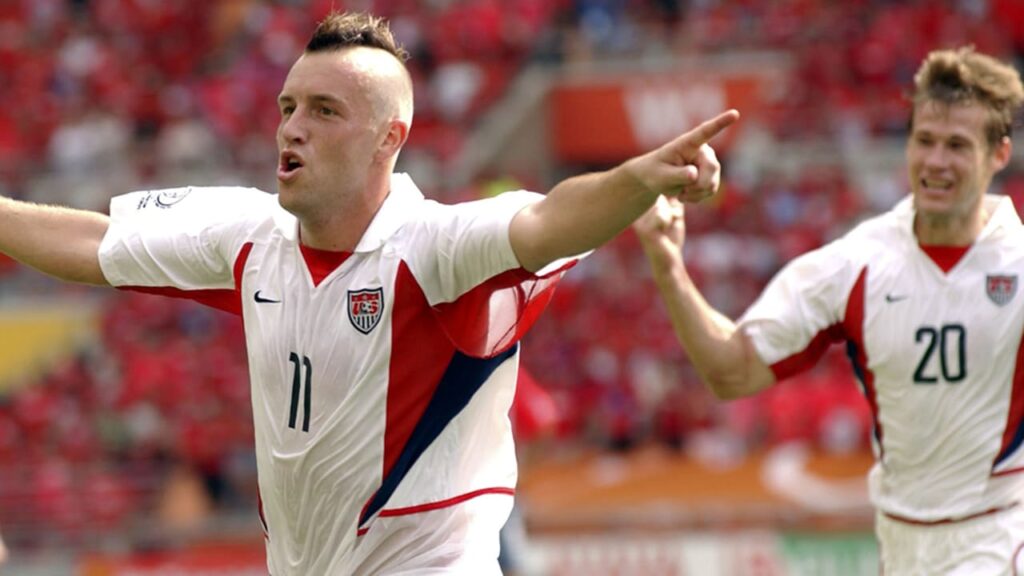
While Clint Mathis had a relatively brief run with the USMNT, his impact on the attacking position was undeniable. Often deployed as a second striker behind Brian McBride, Mathis was anything but traditional—he thrived as a free-roaming attacker capable of changing a match in an instant, highlighted by his ability to score spectacular long-range goals.
He played a key role for the U.S. at the 2002 FIFA World Cup, scoring a memorable goal against South Korea in the group stage and adding an assist, helping power the team’s historic run.
The Evolving Striker Pool (2009 – 2018)
The striker pool from this generation is an interesting mix, some players were only involved with the USMNT for brief stretches, while others carried over from the previous era and overlapped with this group.
Strikers like Edson Buddle and Hercules Gomez, both part of the 2010 World Cup roster, had limited opportunities and production at the international level. Their inclusion was shaped in part by circumstance, as Charlie Davies’ recovery from his car accident less than a year before the tournament ultimately ruled him out of contention.
Looking ahead to 2014, Aron Jóhannsson and Chris Wondolowski earned World Cup roster spots but struggled to make a lasting impact in the biggest matches against top-tier opponents, which limited their long-term roles with the national team.
Players like Jordan Morris, Jesús Ferreira, and Gyasi Zardes emerged and saw increased opportunities following the failure to qualify for the 2018 World Cup. It’s easy to imagine that at least some of that younger group could have factored into the roster had the U.S. made it to Russia.
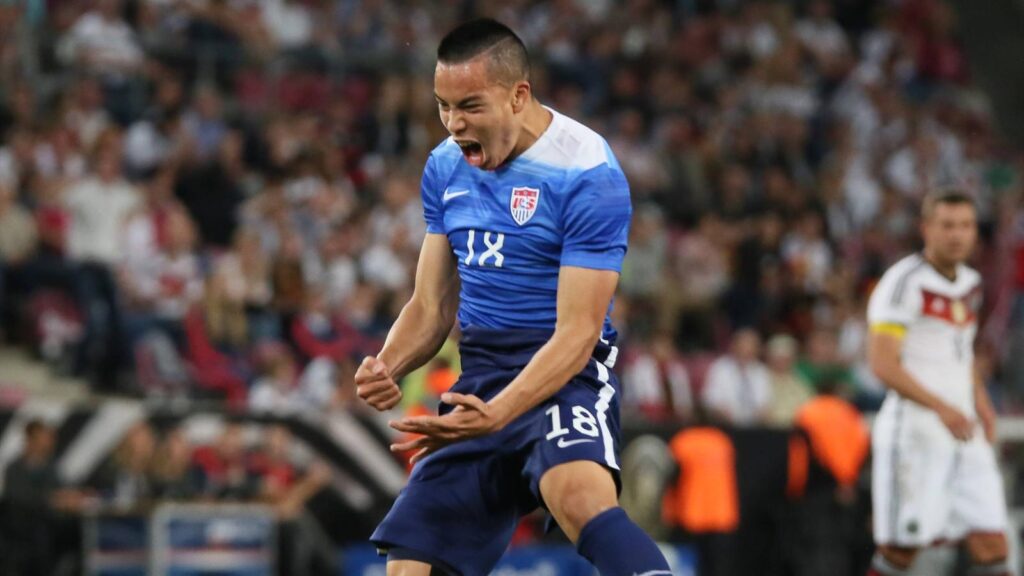
Clint Dempsey (2004 – 2017)
141 Caps, 57 goals, 19 assists
Clint Dempsey delivered some of the most iconic striker moments in USMNT history, big goals, clutch performances, and a relentless ability to show up when it mattered most. While he wasn’t a traditional target striker, his movement, instincts, and technical ability made him one of the most dangerous attacking players the U.S. has ever had.
He scored against top-tier opponents like Spain and Brazil at the 2009 Confederations Cup, found the net against England at the 2010 World Cup to help secure a crucial draw, and famously opened the scoring just seconds into the 2014 World Cup. He also delivered in the 2016 Copa América, with key goals against Ecuador in the quarterfinal and Paraguay in the group stage.
Dempsey wasn’t just a scorer, he was a moment-maker. Whether it was a scrappy finish, a composed strike, or stepping up in the biggest matches, he consistently delivered when the U.S. needed him most.
Jozy Altidore (2007 – 2019)
115 Caps, 42 goals, 14 assists
Jozy Altidore had a unique USMNT career, less about highlight-reel volume and more about physical presence, hold-up play, and stepping up in key moments. At his best, he was the focal point of the attack and a difference-maker. Jozy’s work ethic seemed to impact later stages of his club and USMNT career and impacted him becoming the all-time leading scorer in USMNT history.
Bobby Wood (2013 – 2018)
43 Caps, 13 goals, 3 assists
If it weren’t for Jürgen Klinsmann’s support after Bobby Wood secured a new club in Germany, it’s unclear whether his international career would have continued. While his peak was relatively brief at both club and national level, Wood made his mark with clutch moments, most memorably scoring game-winning goals in back-to-back 2015 friendlies: a 4–3 comeback victory over the Netherlands and a 2–1 win against Germany.
The Next Generation: Assessing the Future of USMNT Strikers
The current USMNT striker pool remains very unsettled. At the moment, Ricardo Pepi is the only regular forward to reach double-digit goals, with 13. He’s followed by Folarin Balogun with eight and Haji Wright with seven. Other notable names in the mix include Josh Sargent and Patrick Agyemang, each of whom has contributed five goals at the international level. However, Agyemang suffered an Achilles injury and has been ruled out of the World Cup, a significant setback given his recent form. For the USMNT to be successful at the 2026 FIFA World Cup their strikers will be a key role and contributing to the teams’ goals scored.
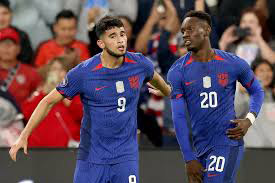
From a club perspective at the time of the article, Balogun is in excellent form, and the hope is that continues through the 2026 FIFA World Cup. At this point, it feels clear that Balogun and Pepi have established themselves as the top two striker options. The bigger question, though, is who else will step up to provide the depth and quality needed to sustain the position in this cycle and beyond.
USMNT
Entry into US Men’s National Fandom

Thomas Deschaine (@uskeeper on X and us_keeper on Instagram)
Every soccer fan has a player or a moment or signature win that pulls them into the game and binds them to a team, no matter how high or low the journey becomes.
For me, that moment was tied to the U.S. Men’s National Team hosting the 1994 World Cup, along with my own recent introduction to the sport as the starting goalkeeper for my school team. Tony Meola, in particular, stood out as one of many important icons and trailblazers for the USMNT during that era.
I imagine there are countless young fans around the world who have already had, or will soon have, that defining moment over the last few years: discovering their first international team and the players they’ll root for and follow for years to come.
Before the 1990 World Cup cycle, those moments were rare for the USMNT. The United States hadn’t even reached the final round of CONCACAF World Cup Qualifying. Their closest opportunity came during the 1986 cycle, when all the U.S. needed was a draw at home against Costa Rica, a result they had achieved just five days earlier on the road in Costa Rica.
In the 1980s, the USMNT qualified for the Olympics three times, once automatically as the host nation in 1984 and twice through the qualifying tournament. It’s also worth noting that Mexico was disqualified during both the 1980 and 1988 qualifying cycles.
Despite qualifying, the U.S. withdrew from the 1980 Olympics in protest of the Soviet invasion of Afghanistan. In the tournaments they did play (1984 and 1988), the USMNT struggled to make an impact, failing to advance out of the group stage and managing just one combined win across both competitions.
USMNT on the Rise (1988-1998)
This generation of trailblazers put the U.S. Men’s National Team back on the map—ending a 40-year World Cup drought, hosting the 1994 World Cup, and advancing further than the world expected.
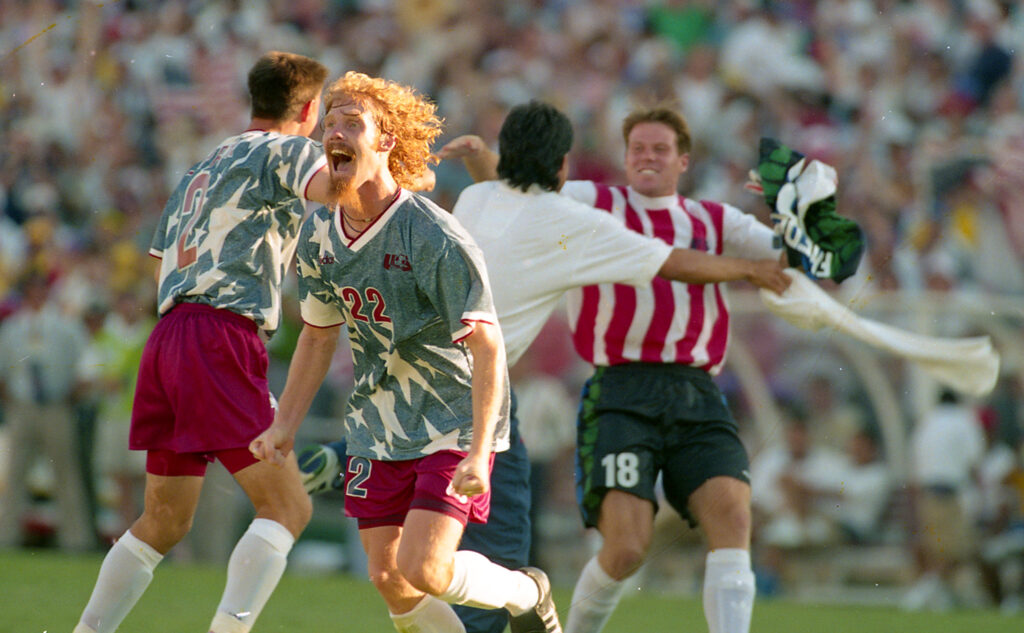
1989 WCQ neutral side in Honduras vs El Salvador
A rare win away from home soil keeps US in hunt to qualify for 1990 World Cup.
1989 – Qualification at Trinidad & Tobago
The win in Port of Spain sends the US to its first World Cup since 1950.
1990 – Return to the World Cup (Italy)
Results were tough, but simply qualifying restarted the program on the world stage.
1991 – USA 2–0 Mexico (Gold Cup)
The USMNT’s first “Dos a Cero” win against Mexico to advance to the first Gold Cup Final.
1993 – USA 2-0 England (U.S. Cup)
The USMNT first win against England since the 1950 World Cup.
1994 – USA 2–1 Colombia (World Cup)
One of the biggest upsets in World Cup history; launched U.S. soccer into the mainstream.
1995 – USA 3-0 Argentina (Copa America)
The apex win for this generation of USMNT trailblazers.
1998 – USA 1-0 Brazil (Gold Cup)
The USMNT only win over Brazil to date.
Earning Respect from the World (1999-2010)
After a disappointing performance at the 1998 World Cup, the USMNT reset by hiring American coach Bruce Arena. That decision, combined with the emergence of impactful young players, helped restore credibility and earn growing respect on the global stage—culminating in a deep and memorable run at the 2002 World Cup.
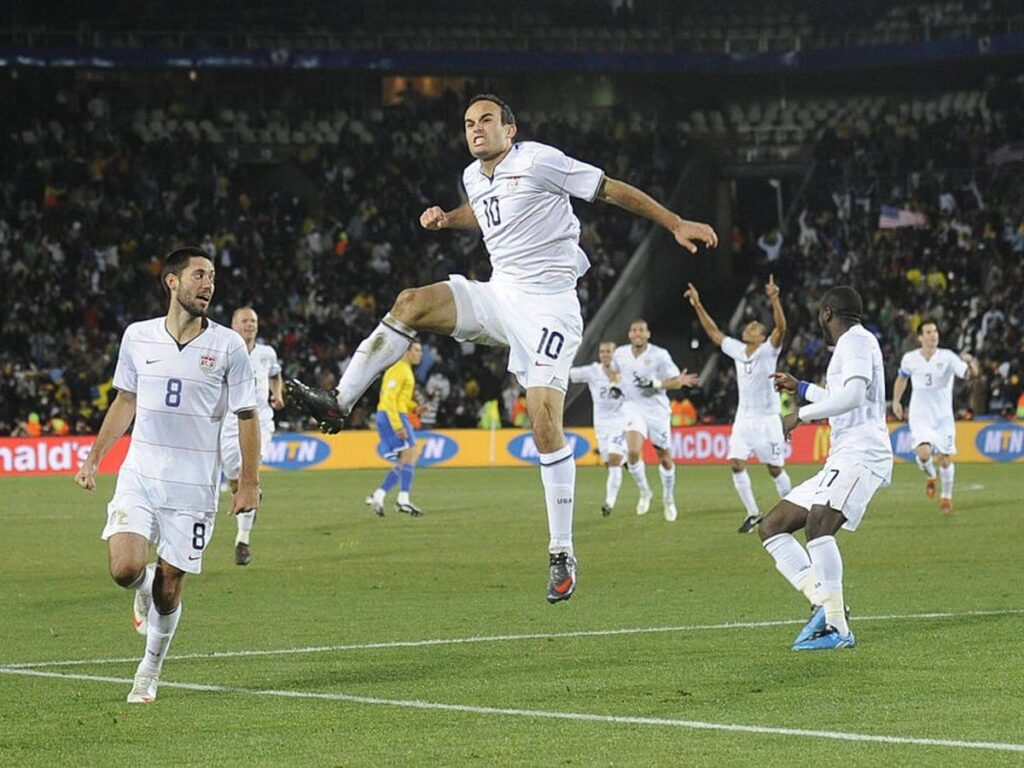
1999 – 2-0 Win over Germany (Confederations Cup)
USMNT second win over Germany in 1999.
2001 – First “Dos a Cero” vs Mexico in Columbus (World Cup Qualifier)
A rivalry-defining moment and a psychological turning point.
2002 – USA 3–2 Portugal (World Cup)
The world took notice. One of the greatest performances in USMNT history.
2002 – USA 2–0 Mexico (World Cup Round of 16)
Dominance over rival Mexico on the biggest stage.
2002 – World Cup Quarterfinal run (loss 1–0 to Germany)
Even in a loss the USMNT deepest World Cup run got attention from most.
2005 – USA 2-0 Mexico in Columbus (World Cup Qualifier)
USMNT WCQ win over Mexico qualified them for the World Cup.
2007 – Gold Cup Final: USA 2–1 Mexico (Gold Cup)
A signature win in Chicago with a classic Donovan goal.
2009 – USA 2–0 Spain (Confederations Cup)
Ends Spain’s 35-match unbeaten streak in a historic semifinal upset.
2010 – Donovan vs Algeria (90+1’)
The most iconic goal in USMNT history; dramatic group-stage escape.
The Klinsmann Era (2011-2017)
When Jürgen Klinsmann was hired to replace Bob Bradley, he introduced a new mindset for the USMNT, challenging players to compete at higher levels with their clubs. The opponents he scheduled during his tenure reflected that philosophy, consistently pushing the team against stronger international competition.
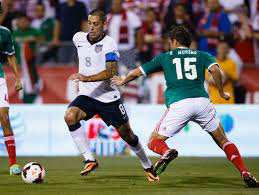
2012 – USA 1-0 Italy (Friendly)
A key road win for the USMNT under Klinsmann.
2012 – USA 1-0 Mexico (Friendly)
The Americans first ever win at Azteca in Mexico.
2013 – USA 4-3 Germany (Centennial Match)
Celebrating their centennial match in style with a win.
2013 – USA 4-3 Bosnia-Herzegovina (Friendly)
A comeback road win against the 13th ranked Bosnia-Herzegovina.
2013 – USA 2-0 Mexico (World Cup Qualifier)
Nothing better than Dos a Cero that qualifies you for the World Cup.
2014 – USA 2–1 Ghana (World Cup)
Revenge at last, with a clutch John Brooks header helping to advance from Group of Death.
2015 – USA 4-3 Netherlands (Friendly)
A thrilling comeback victory on the road against the Netherlands.
2015 – USA 2-1 Germany (Friendly)
Days after beating the Netherlands, the USMNT topped Germany in a hard-fought match.
2016 – USA 2-1 Ecuador (Copa America)
A quarter-final win for the Americans who advance to the semi-finals of Copa America.
The Rise of a New Generation (2018-Current)
After the failure to qualify for the 2018 World Cup, the USMNT landscape began to shift. A greater emphasis was placed on integrating younger players into the national team, even as it became increasingly difficult for the U.S. to schedule friendlies against top-level opponents from Europe and South America.
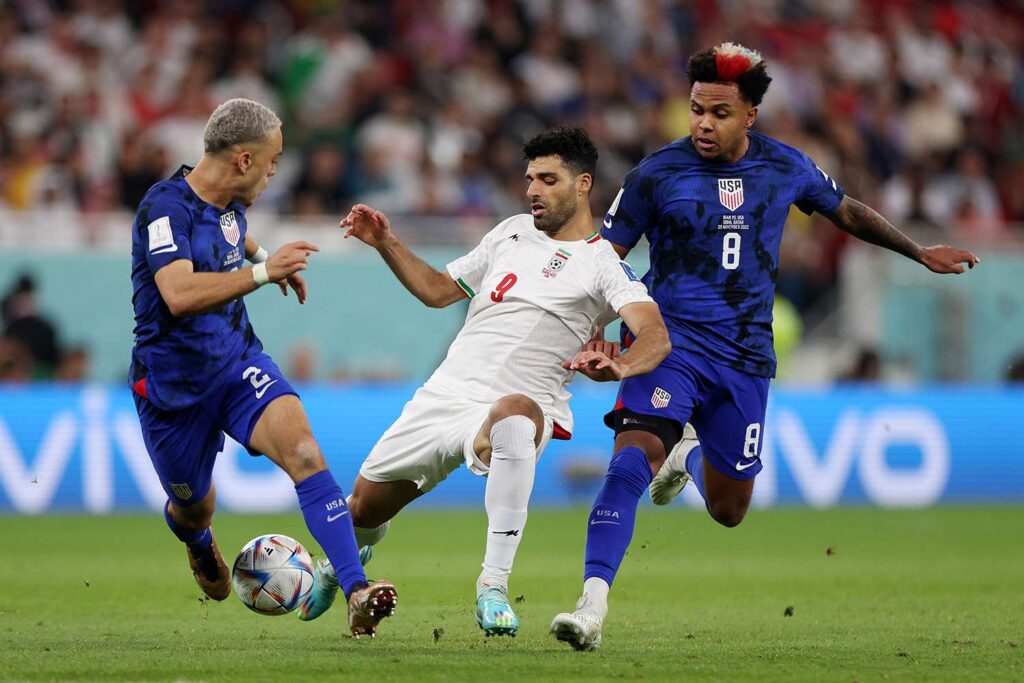
2021 – USA 3-2 Mexico (Nations League)
This extra-time win sparked a period of dominance over Mexico.
2022 – USA 3-0 Morocco (Friendly)
A victory over the eventual fourth-place finisher at the 2022 World Cup.
2022 – USA 1-0 Iran (World Cup)
A first-half strike from Christian Pulisic propels the U.S. into the knockout stage.
2023 – USA 3-0 Mexico (Nations League)
A dominant semifinal win preceded Gregg Berhalter’s rehiring.
2024 -USA 2-0 Mexico (Nations League)
Another victory over El Tri, extending the unbeaten run to seven matches.
A Chance to Win will bring in New Believers Ahead of 2026
The USMNT has a prime opportunity to build momentum and attract new supporters ahead of the 2026 World Cup, with upcoming friendlies against European powers Belgium, Portugal, and Germany, along with AFCON champions Senegal. These high-profile matchups offer a rare spotlight and a chance to measure themselves against the world’s best.
A deep World Cup run, reaching the quarterfinals or beyond, would go a long way toward winning and retaining new fans. But to truly grow the fanbase, success must be consistent, with fewer lapses and a standard of performance that reinforces belief long after the tournament ends.
USMNT
Breaking the Mold: Freese a Unique USMNT Goalkeeper
Thomas Deschaine (@uskeeper on X and us_keeper on Instagram)
With only the March window left before Mauricio Pochettino finalizes the 2026 World Cup roster, one major question remains: who can truly be trusted to guard the net? It’s a debate still dividing media, fans, and observers alike.
The USMNT has produced some legendary goalkeepers over the past four decades, but the current pool has yet to see anyone truly seize the No. 1 spot. For a while, it looked like Matt Turner might start in back-to-back World Cups, but after a poor summer performance against Switzerland, he lost his place to Matt Freese. Freese went on to start the last thirteen matches, yet outside of his heroics in the 2025 Gold Cup penalty shootout, echoing Turner’s run in 2023, Freese hasn’t fully convinced me he should be the starter at the 2026 FIFA World Cup.
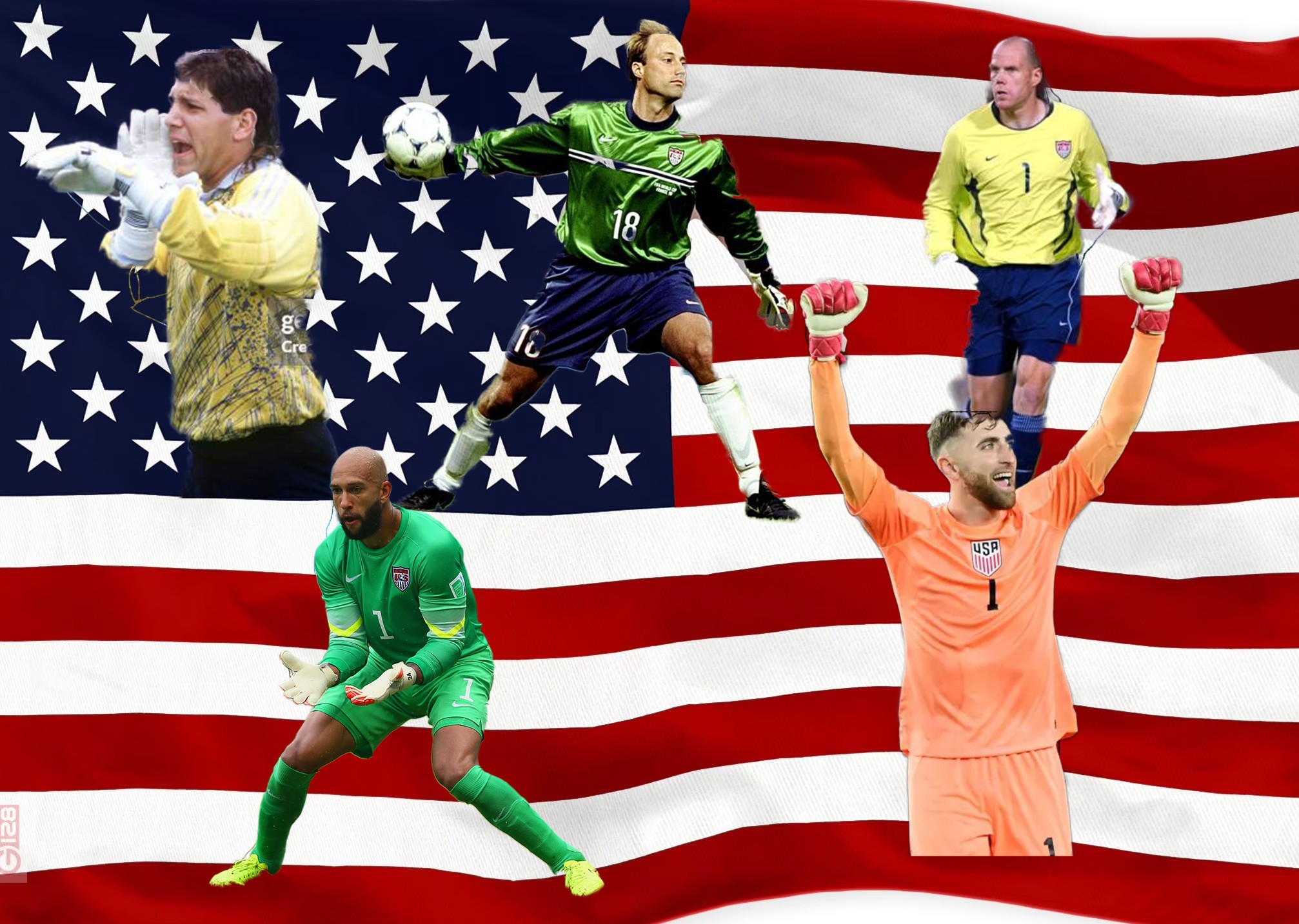
Since the 1990 cycle, five USMNT goalkeepers, Tony Meola, Kasey Keller, Brad Friedel, Tim Howard, and Matt Turner, have earned the World Cup starting role. Each of them logged minutes in the grueling World Cup qualifying process before taking the job. But Matt Freese could become the first USMNT goalkeeper to start a World Cup without ever playing a single qualifier.
Tony Meola – 1990 Italy World Cup
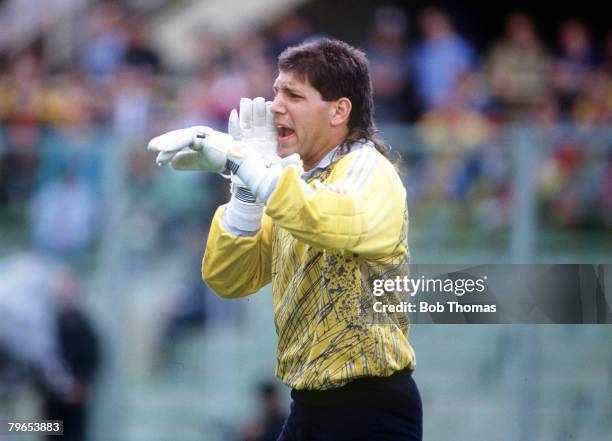
Creator: Bob Thomas | Credit: Getty Images
Tony Meola remains the youngest goalkeeper ever to start a World Cup for the USMNT. He went on to start in back-to-back tournaments and later served as the backup at the 2002 World Cup alongside Brad Friedel and Kasey Keller.
First Cap (Age) – June 7, 1998 (19 years, 3 month & 17 days)
World Cup 1990 (Age) – (21 years, 3 months, 10 days)
Overall Stats heading into the World Cup
Matches Played – 17
Matches Started – 15
Minutes Played – 1,395
Wins – 7
Shutouts – 6
World Cup Qualifying Stats
Matches Played – 4
Matches Started – 4
Minutes Played – 360
Wins – 2
Shutouts – 4
Kasey Keller – 1998 France World Cup
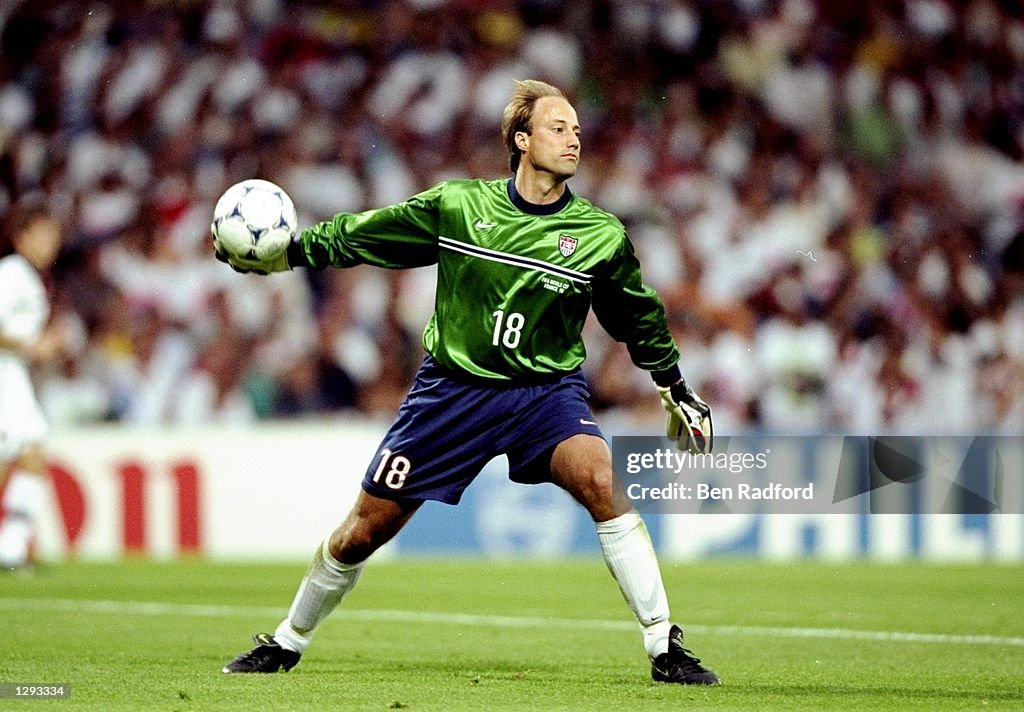
Kasey Keller, one of the backups to Tony Meola at the 1990 World Cup, was left off the 1994 roster but later reestablished himself in the USMNT picture. He went on to become the primary starter for the 1998 and 2006 World Cups and served as the backup on the 2002 team.
Creator: Ben Radford | Credit: Getty Images
First Cap (Age) – February 4, 1990 (20 years, 2 months & 6 days)
World Cup 1998 (Age) – (28 years, 6 months, 15 days)
Overall Stats heading into the World Cup
Matches Played – 34
Matches Started – 33
Minutes Played – 2,790
Wins – 18
Shutouts – 16
World Cup Qualifying Stats
Matches Played – 9
Matches Started – 9
Minutes Played – 810
Wins – 5
Shutouts – 6
Brad Friedel – 2002 Korea/Japan World Cup
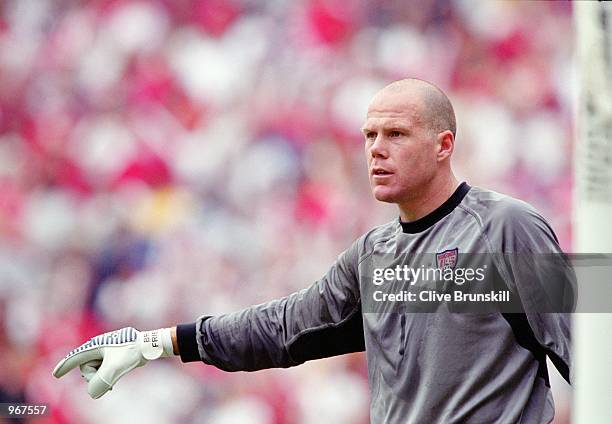
Creator: Clive Brunskill | Credit: Getty Images
Brad Friedel, who started all five U.S. matches at the 2002 World Cup and made one start in 1998, earned a place on three USMNT World Cup squads during his career.
First Cap (Age) – September 3, 1992 (21 years, 3 months, 16 days)
World Cup 2002 (Age) – (31 years, 0 months, 5 days)
Overall Stats heading into the World Cup
Matches Played – 76
Matches Started – 74
Minutes Played – 6,453
Wins – 25
Shutouts – 23
World Cup Qualifying Stats
Matches Played – 13
Matches Started – 13
Minutes Played – 1,125
Wins – 7
Shutouts – 4
Tim Howard – 2010 South Africa
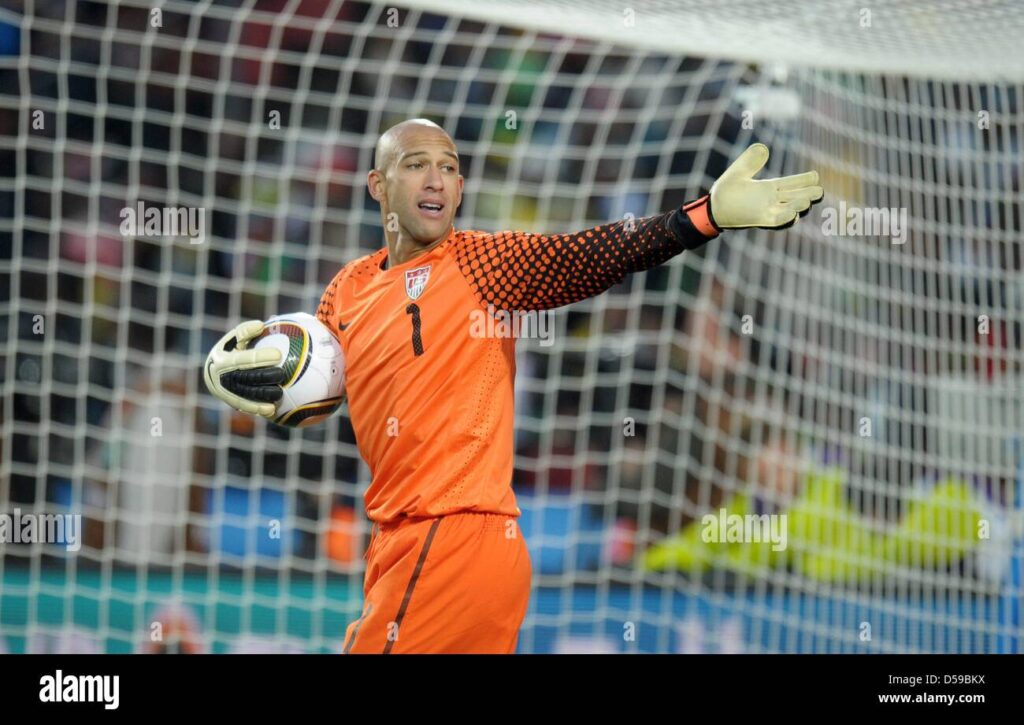
Creator: Ronald Wittek | Credit: Alamy
Tim Howard, the oldest first-time World Cup starter among this group, may also be the most accomplished. He appeared on three World Cup rosters, and likely would have made a fourth had the USMNT qualified in 2018.
First Cap (Age) – March 10, 2002 (23 years, 0 months, 4 days)
World Cup 2010 (Age) – (31 years, 3 months, 12 days)
Overall Stats heading into the World Cup
Matches Played – 51
Matches Started – 50
Minutes Played – 4,185
Wins – 31
Shutouts – 23
World Cup Qualifying Stats
Matches Played – 16
Matches Started – 16
Minutes Played – 1,440
Wins – 12
Shutouts – 8
Matt Turner – 2022 Qatar
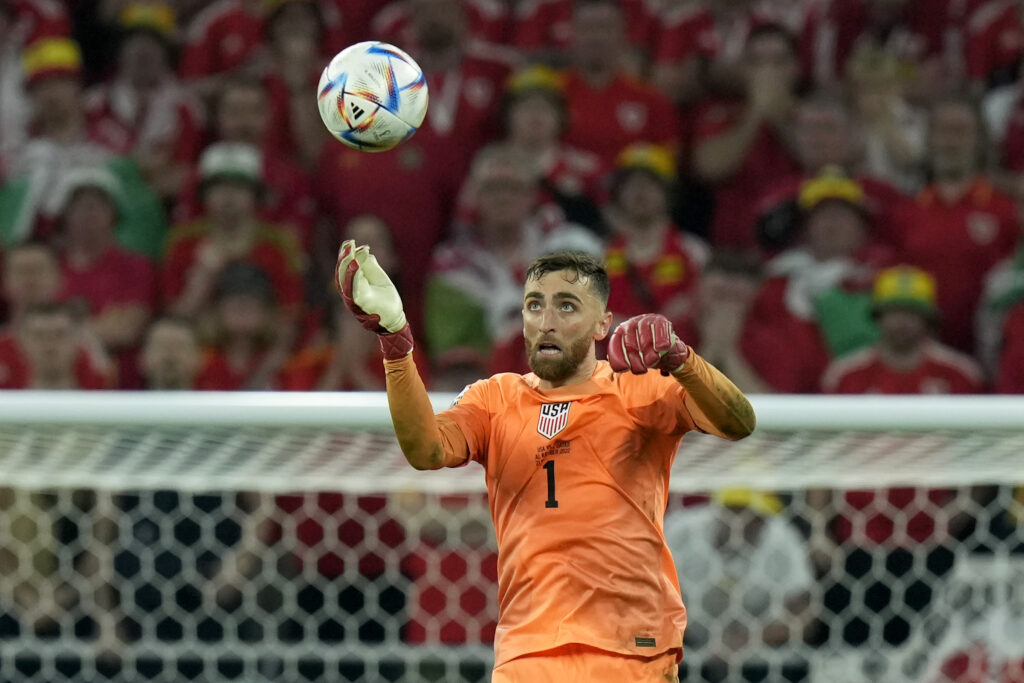
Creator: Francisco Seco | Credit: AP
Turner seized his opportunity when an unwell Zack Steffen was forced off the roster to start the World Cup qualifying, stepping in to start the first of eight World Cup qualifiers. His performances solidified his place as the USMNT’s starting goalkeeper for the 2022 World Cup.
First Cap (Age) – January 31, 2021 (26 years, 9 months, 3 days)
World Cup 2022 (Age) – (28 years, 4 months, 21 days)
Overall Stats heading into the World Cup
Matches Played – 20
Matches Started – 20
Minutes Played – 1,800
Wins – 14
Shutouts – 14
World Cup Qualifying Stats
Matches Played – 8
Matches Started – 8
Minutes Played – 720
Wins – 4
Shutouts – 4
Matt Freese
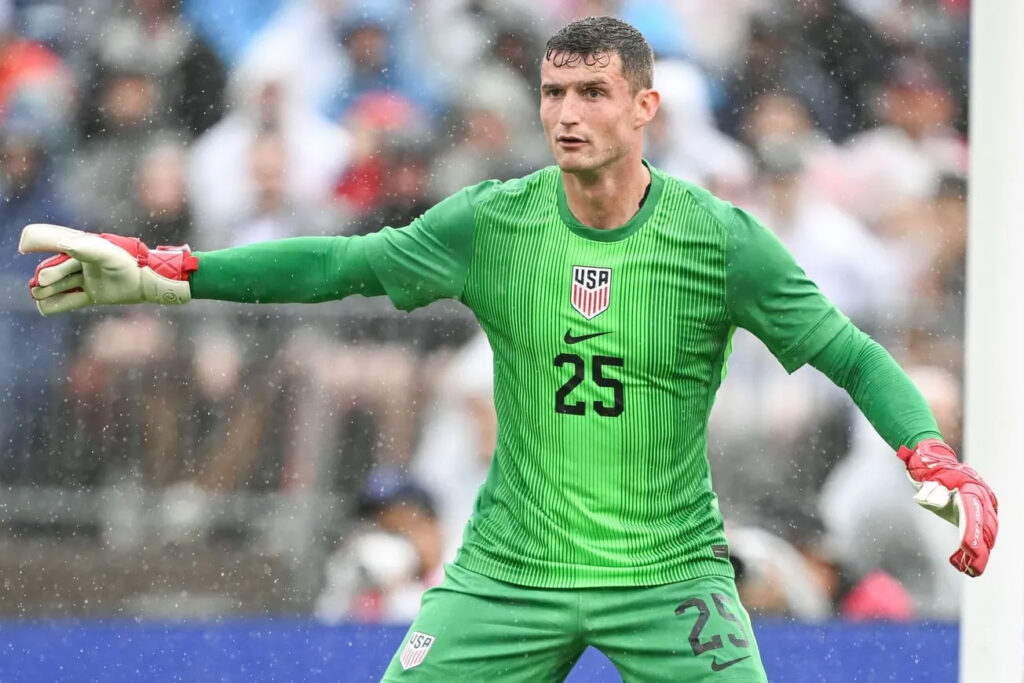
Courtesy USMNT
Matt Freese would have the shortest runway of any USMNT goalkeeper, from earning his first cap to potentially starting at a World Cup. He would also become the first U.S. keeper to start at a World Cup without having played a single World Cup qualifier.
First Cap (Age) – June 5, 2025 (26 years, 9 months, 3 days)
World Cup 2026 (Age) – (27 years, 9 months, 12 days)
Overall Stats heading into the World Cup
Matches Played – 13
Matches Started – 13
Minutes Played – 1,170
Wins – 7*
Shutouts – 3*
World Cup Qualifying Stats
Matches Played – n/a
Matches Started – n/a
Minutes Played – n/a
Wins – n/a
Shutouts – n/a
It’s clear the USMNT doesn’t have a true front-runner in goal even though Mauricio Pochettino currently leans toward Matt Freese, but as we’ve seen, things can change fast. Matt Turner, Patrick Schulte, Chris Brady, Roman Celentano, and Jonathan Klinsmann will all need to push hard to earn their place on the final roster.


The No. 9 Timeline: A Historical Look at USMNT Strikers

Entry into US Men’s National Fandom

Breaking the Mold: Freese a Unique USMNT Goalkeeper
-

 Club News2 years ago
American Transfers: Stock Up & Stock Down
-
 USMNT2 years ago
USMNT Kits Come in Different Styles and Colors
-
 Club News6 years ago
CJ dos Santos, Benfica
-
 USMNT5 years ago
A Hidden Gem: Barça Residency Academy
-
 Club News6 years ago
Julian Vincente Araujo
-
USMNT3 years ago
World Cup Format History
-

 USMNT2 years ago
Is the MLS Specifically Targeting Expansion to USL Cities?
-
 MLS4 years ago
2022 Youth Series: MLS Club Youth Talent Rankings