20. Bryang Kayo: Centro Medio (Wolfsburg)
Bryang Kayo es un nombre que muchos reconocerán porque participó en el reciente campamento de enero. Kayo también estaba entre un grupo de prospectos (incluidos Kobe Hernandez-Foster y Johnny Cardoso) que se rumorea fueron convocados para los amistosos de USMNT que se suponía debieron haber tenido lugar en marzo. Kayo se dirige a Wolfsburg, donde en realidad puede saltar el nivel u19 y ser trasladado directamente a su equipo de reserva. Kayo es una versión más joven de Weston McKennie con más destreza técnica. Kayo podría entrar en el primer equipo de Wolfsburg en los próximos dos años y tiene la oportunidad de convertirse en un miembro de la piscina USMNT para este ciclo (una pequeña oportunidad … pero aún así una oportunidad).
19. Cameron Harper: Winger (Celtic FC)
Cameron Harper es el extremo que es conocido por pocos, pero altamente calificado por aquellos que son conscientes de su juego. Harper está aumentando rápidamente en Celtic y podría entrar en sus listas de juegos en el otoño. Harper es un extremo rápido que puede vencer a los defensores a voluntad. Harper ha sido el destacado hasta ahora en los campamentos de la Copa Mundial de U20 y si Uly Llanez es retenido de los U20, Harper se insertará en la alineación titular y será el jugador de ruptura en este grupo.
18. Brooklyn Raines: Centro Medio (Barca Academy AZ)
La Academia Barca en Casa Grande, Arizona ha producido algunos jugadores muy talentosos recientemente, Brooklyn Raines es el jugador más talentoso del grupo. Brooklyn es una versión más peligrosa de Tyler Adams. Brooklyn es muy buena posición y puede hacer bien en tacleadas de campo para recuperar y retener la posesión. Brooklyn está en la vía rápida a Europa, donde debe entrar en un equipo en al estylo de Tyler Adams como la moda donde inmediatamente se convierte en un jugador valioso para el centro del campo de un equipo. Brooklyn estará en el grupo del equipo nacional juvenil por otros 8 años y será el primer jugador en el equipo durante todo su mandato del equipo nacional juvenil.
17. Tanner Tessmann: Centro Medio (FC Dallas)
Tanner Tessmann ha disparado las listas más aun más que cualquier otro prospecto recientemente y es porque decidió firmar con el primer equipo del FC Dallas en lugar de perder el tiempo pateando por Clemson. Como dijo Dabo Swinney, Tanner es atléticamente dotado y su juego lo muestra en el campo. Tanner entró en la alineación titular del FC Dallas con facilidad, lo cual es algo que Paxton Pomykal no pudo hacer a los 18 años, lo que demuestra el potencial que tiene Tessmann. Tanner debe ser el gran ganador de la Copa Mundial sub-20 y debe reservar un boleto para un primer equipo europeo para ello.
16. Antonio Leone: Centro trasero (LAFC)
Es raro cuando hay una perspectiva de centro hacia atrás que se destaca entre la multitud cuando su grupo de edad es 16 años de edad, pero Tony ha logrado hacer esto. Tony es un prospecto de centro de élite que tiene el tamaño, el control de la pelota, el coeficiente intelectual y el juego agresivo para ser élite como centro de atrás. En este momento Leone está en peligro de cambiar a México, lo que sería una pérdida masiva para los Estados Unidos, ya que Leone fue enviado a la banca en el último campamento de EE. Esperemos que por el bien del centro a largo plazo de la espalda de la piscina, Tony se da cuenta de que el último campamento no estaba destinado a evaluar las cerraduras del grupo de edad y se junta con los buenos.
15. Jonathan Pérez: Winger/Attacking Mid (LA Galaxy)
Johnny Pérez es uno de los creadores de juegos más dinámicos en la piscina. Johnny es la perspectiva dinámica de creación de juegos que LA Galaxy realmente pudo retener después de que Uly Llanez se fue a Alemania. Johnny juega con mayor frecuencia como extremo derecho, pero es mejor como un 10 donde realmente se separa de la manada. Johnny constantemente hace jugadas y cambia el juego sin importar con quién juega contra. A principios de este año, Johnny hizo su debut en la USL y recogió una asistencia dentro de los 10 minutos de entrar en el campo y claramente se destacó de todas las otras perspectivas muy talentosas en el campo. Pérez es la mayor batalla nacional dual que Estados Unidos tiene actualmente con México, ya que Johnny juega actualmente para los malos y es el mejor jugador para los México 03 que son significativamente menos talentosos que los EE.
14. Jose Gallegos: Atacando a Mid (San Antonio FC)
José será el primer prospecto importante en salir de una academia de la USL. José es un clásico número 10 que puede diseccionar una defensa y facilitar la ofensiva de su equipo. José es, con mucho, el mejor jugador en San Antonio ya y todavía está en el último año en la escuela secundaria. Con Gio Reyna probablemente ser retenido del ciclo de la Copa Mundial sub20 José debería ser el titular en el 10. Anthony Hudson estuvo recientemente en el Podcast de BSI donde elogió la habilidad y el potencial de Gallegos.
13. Taylor Booth: Defensivo Medio (FC Bayern Munich)
Taylor Booth es uno de los pocos prospectos que no es de California (de echo puede ser el único) que la tripulación 343 realmente califica. Taylor Booth es un medio defensivo resistente a la prensa que es valioso en el ataque y no es un turnstyle defensivo. Taylor se encuentra actualmente en el Bayern Munich, pero su tiempo allí se está cerrando ya que no tiene el potencial de entrar en su primer equipo (no es realista esperar que lo haga). Taylor tiene la capacidad de pasar a una mesa media de la Bundesliga y puede romper durante el próximo año. Taylor luchará con Johnny Cardoso durante mucho tiempo para ser el 6 en el ciclo de la Copa Mundial sub20 y el ciclo olímpico 2024.
12. Julian Araujo: Espalda Derecha (LA Galaxy)
Julian Araujo debería ser el capitán del actual ciclo de la Copa Mundial sub-20 y será un lateral derecho que debería estar involucrado en las listas de USMNT durante mucho tiempo. Debido a que Mauricio Cuevas también está en el sistema Galaxy, Araujo debería ser trasladado a Europa lo más rápido posible , donde prosperará. Araujo es una de las apuestas más seguras para convertirse en la copia de seguridad de Sergino Dest a largo plazo.
11. Owen Otasowie: Centro de espalda/medio defensivo (Wolverhampton FC)
Owen Otasowie es una bestia de jugador que actualmente juega su oficio en Wolverhampton en la Premier League. Owen ya ha hecho su debut en la Premier League y ha atraído a los interesados de varios clubes de Europa y Wolverhampton tuvo que moverlo al primer equipo para mostrar cuán altamente calificado está en el club. Owen es el mejor prospecto central que Estados Unidos tiene en la piscina de la Copa Mundial sub20. Owen debe ser considerado para el ciclo olímpico actual y debe ser un jugador clave para el próximo ciclo. Owen será un jugador a tener en cuenta para el Ciclo de la Copa del Mundo 2026.
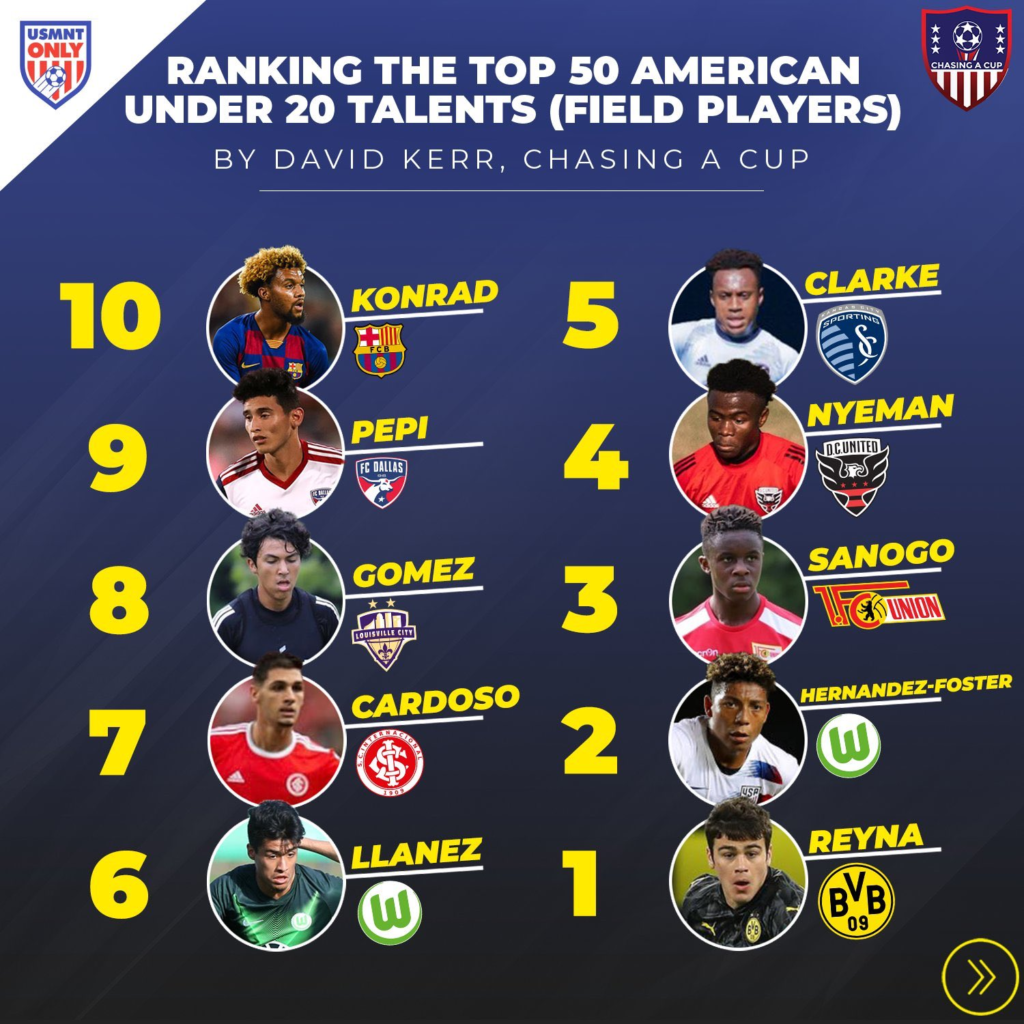
10. Konrad De La Fuente: Winger (FC Barcelona)
Konrad es el extremo más subestimado en el grupo de la selección nacional juvenil. Konrad lo está iluminando para los equipos juveniles del FC Barcelona y, sin embargo, nunca se lo habla como un prospecto USMNT de primer nivel por la mayoría de los fanáticos, lo que no entiendo. Konrad tuvo una áspera Copa del Mundo sub20, pero también fue el jugador más joven del equipo y aún así logró comenzar todos los partidos para un equipo que sorprendió a Francia y también tuvo Uly Llanez. Konrad se quedará en el FC Barcelona para el próximo año, pero los aficionados deberían estar esperando que se mueva a Alemania y se rompa en un equipo de la Bundesliga después de la Copa Mundial U20 del próximo verano.
9. Ricardo Pepi: Delantero (FC Dallas)
Ricardo Pepi es un delantero que puede hacerlo todo. Se puede combinar con sus compañeros de equipo, se puede estirar una línea de fondo, y él puede golpear en los objetivos. Pepi anotó 18 goles en 7 juegos en el nivel de DA u17, lo cual es absurdo, posteriormente ingresó a la USL League 1 y anotando un hattrick en su primer juego. Pepi tiene que mejorar su espalda a la capacidad de meta, pero cuando lo haga será un delantero de élite. Pepi debería ser el titular de la selección nacional de la Copa Mundial sub20 y será un objetivo europeo caliente después de la Copa Mundial sub20 en 2021.
8. Jonathan Gomez: Espalda Izquierda (Louisville City FC)
FC Dallas es una fábrica de súper talentos y Jonathan Gomez es el mejor talento para salir de su academia. Gómez es un lateral izquierdo que puede hacerlo todo. Gómez tiene el coeficiente intelectual, la habilidad y la mentalidad necesarias para llegar lejos en el juego. Jonathan se ha mudado del FC Dallas al Louisville City FC, donde jugará guiado por John Hackworth, quien vio prosperar múltiples perspectivas estadounidenses. Gómez se trasladará a Europa el próximo año y llegará lejos. Esté atento a este chico porque es una de las dos respuestas a la crisis de la espalda izquierda que el USMNT ha tenido en la última década.
7. Johnny Cardoso: Defensivo Medio (Internacional)
Muchos fanáticos a menudo se quejan de que Gregg Berhalter no presta atención a los jugadores fuera de la MLS. Gregg ha derribado rápidamente esa suposición al reclutar a Johnny Cardoso en el sistema de EE. Cardoso ha sido nombre comprobado por Gregg varias veces como una perspectiva no se puede perder. Cardoso ha entrado en el primer equipo internacional en Brasil y se necesita una capacidad técnica superior y fuerza mental para hacerlo en un país donde las perspectivas están luchando para escapar de una vida de pobreza en las favelas. Cardoso es un bloqueo en el 6 para el ciclo actual u20 y será una figura constante en las hojas del equipo de EE.
6. Uly Llanez: Winger (Wolfsburg)
Uly Llanez es el jugador que, literalmente, todos los fanáticos de USMNT están pidiendo Gregg Berhalter para integrarse en el USMNT tan pronto como sea posible y por una buena razón, Uly puede jugar. Uly tiene todas las herramientas que buscas en un extremo y debe entrar en el primer equipo de Wolfsburg tan pronto como se reanude la Bundesliga. Si bien hay muchas grandes perspectivas en esta lista, Uly es uno de los únicos bloqueos para ser un contribuyente USMNT en el corto plazo.
5. Nati Clarke: espalda derecha / espalda central (Sporting Kansas City)
En este momento, la gente está encerrando a Sergino Dest en el lugar de partida para la próxima década, pero no deberían debido a Nati Clarke. Nati puede ser el jugador más atléticamente dotado en toda esta lista, pero ser atléticamente dotado no le da su lugar en el top 5. Nati tiene todas las herramientas técnicas en su juego y si Sporting Kansas City puede desarrollar su coeficiente intelectual de fútbol, entonces Nati rápidamente estará atado a Europa y encerrado en una alineación titular para quien pueda firmarlo. Al buscar un jugador joven para entrar en el USMNT para el ciclo de la Copa del Mundo 2026, Nati Clarke tiene la mayor probabilidad de todos ellos, ya que tendrá 21 en 2026.
4. Moses Nyeman: Centro Medio/Atacante Medio (DC United)
Moisés Nyeman será un bloomer tardío, pero cuando florece será grande. Moisés puede literalmente hacerlo todo. Moisés es excepcional en todos los aspectos del juego y está listo para la MLS a pesar de ser el jugador más pequeño que verás en el campo. Moisés no tiene potencial de estrellas, tiene potencial de superestrella. Lo único que separa a Moisés de ser una estrella en el campo son sus atributos físicos.
3. Malick Sanogo: Delantero/extremo (FC Union Berlin)
Malick Sanogo es el mejor prospecto delantero que Estados Unidos no ha nombrado Josh Sargent. El fútbol corre en las venas de Sanogo cuando su padre fue contratado como entrenador delantero en Union Berlin. Sanogo actualmente es el segundo entre todos los 2004 en las ligas juveniles alemanas por goles y asistencias, el jugador que lo lidera es Youssoufa Moukoko, que es un talento generacional. Estar produciendo a todos los demás jugadores de su edad en Alemania habla de volumen sobre el talento de Malick. Sin un segundo equipo en Union Berlin, la integración de Malick en el primer equipo será pronto. Malick podría abrirse paso en su primer equipo antes de la Copa Mundial 2022 y es el jugador de doble nacional de mayor prioridad que Estados Unidos tiene.
2. Kobe Hernandez-Foster: Espalda Izquierda (Wolfsburg)
Kobe es el mejor prospecto de izquierda que Estados Unidos haya tenido. Kobe fue tan valioso para el equipo de la Copa Mundial Sub-17 de 2019 que tuvieron que comenzarlo como centro porque era el mejor centro del equipo a pesar de que no era su posición natural. Kobe probablemente irrumpirá en el primer equipo de Wolfsburg el próximo año y se convertirá en el lateral izquierdo que el USMNT ha estado perdiendo. Gregg Berhalter debe tallar el nombre de Kobe en la alineación titular en el lateral izquierdo porque Kobe estará en la piscina salvo que ocurra una lesión crítica.
1. Gio Reyna: Winger/Attacking Mid (Borussia Dortmund)
20. Bryang Kayo: Centro Medio (Wolfsburg)
Bryang Kayo es un nombre que muchos reconocerán porque participó en el reciente campamento de enero. Kayo también estaba entre un grupo de prospectos (incluidos Kobe Hernandez-Foster y Johnny Cardoso) que se rumorea fueron convocados para los amistosos de USMNT que se suponía debieron haber tenido lugar en marzo. Kayo se dirige a Wolfsburg, donde en realidad puede saltar el nivel u19 y ser trasladado directamente a su equipo de reserva. Kayo es una versión más joven de Weston McKennie con más destreza técnica. Kayo podría entrar en el primer equipo de Wolfsburg en los próximos dos años y tiene la oportunidad de convertirse en un miembro de la piscina USMNT para este ciclo (una pequeña oportunidad … pero aún así una oportunidad).
19. Cameron Harper: Winger (Celtic FC)
Cameron Harper es el extremo que es conocido por pocos, pero altamente calificado por aquellos que son conscientes de su juego. Harper está aumentando rápidamente en Celtic y podría entrar en sus listas de juegos en el otoño. Harper es un extremo rápido que puede vencer a los defensores a voluntad. Harper ha sido el destacado hasta ahora en los campamentos de la Copa Mundial de U20 y si Uly Llanez es retenido de los U20, Harper se insertará en la alineación titular y será el jugador de ruptura en este grupo.
18. Brooklyn Raines: Centro Medio (Barca Academy AZ)
La Academia Barca en Casa Grande, Arizona ha producido algunos jugadores muy talentosos recientemente, Brooklyn Raines es el jugador más talentoso del grupo. Brooklyn es una versión más peligrosa de Tyler Adams. Brooklyn es muy buena posición y puede hacer bien en tacleadas de campo para recuperar y retener la posesión. Brooklyn está en la vía rápida a Europa, donde debe entrar en un equipo en al estylo de Tyler Adams como la moda donde inmediatamente se convierte en un jugador valioso para el centro del campo de un equipo. Brooklyn estará en el grupo del equipo nacional juvenil por otros 8 años y será el primer jugador en el equipo durante todo su mandato del equipo nacional juvenil.
17. Tanner Tessmann: Centro Medio (FC Dallas)
Tanner Tessmann ha disparado las listas más aun más que cualquier otro prospecto recientemente y es porque decidió firmar con el primer equipo del FC Dallas en lugar de perder el tiempo pateando por Clemson. Como dijo Dabo Swinney, Tanner es atléticamente dotado y su juego lo muestra en el campo. Tanner entró en la alineación titular del FC Dallas con facilidad, lo cual es algo que Paxton Pomykal no pudo hacer a los 18 años, lo que demuestra el potencial que tiene Tessmann. Tanner debe ser el gran ganador de la Copa Mundial sub-20 y debe reservar un boleto para un primer equipo europeo para ello.
16. Antonio Leone: Centro trasero (LAFC)
Es raro cuando hay una perspectiva de centro hacia atrás que se destaca entre la multitud cuando su grupo de edad es 16 años de edad, pero Tony ha logrado hacer esto. Tony es un prospecto de centro de élite que tiene el tamaño, el control de la pelota, el coeficiente intelectual y el juego agresivo para ser élite como centro de atrás. En este momento Leone está en peligro de cambiar a México, lo que sería una pérdida masiva para los Estados Unidos, ya que Leone fue enviado a la banca en el último campamento de EE. Esperemos que por el bien del centro a largo plazo de la espalda de la piscina, Tony se da cuenta de que el último campamento no estaba destinado a evaluar las cerraduras del grupo de edad y se junta con los buenos.
15. Jonathan Pérez: Winger/Attacking Mid (LA Galaxy)
Johnny Pérez es uno de los creadores de juegos más dinámicos en la piscina. Johnny es la perspectiva dinámica de creación de juegos que LA Galaxy realmente pudo retener después de que Uly Llanez se fue a Alemania. Johnny juega con mayor frecuencia como extremo derecho, pero es mejor como un 10 donde realmente se separa de la manada. Johnny constantemente hace jugadas y cambia el juego sin importar con quién juega contra. A principios de este año, Johnny hizo su debut en la USL y recogió una asistencia dentro de los 10 minutos de entrar en el campo y claramente se destacó de todas las otras perspectivas muy talentosas en el campo. Pérez es la mayor batalla nacional dual que Estados Unidos tiene actualmente con México, ya que Johnny juega actualmente para los malos y es el mejor jugador para los México 03 que son significativamente menos talentosos que los EE.
14. Jose Gallegos: Atacando a Mid (San Antonio FC)
José será el primer prospecto importante en salir de una academia de la USL. José es un clásico número 10 que puede diseccionar una defensa y facilitar la ofensiva de su equipo. José es, con mucho, el mejor jugador en San Antonio ya y todavía está en el último año en la escuela secundaria. Con Gio Reyna probablemente ser retenido del ciclo de la Copa Mundial sub20 José debería ser el titular en el 10. Anthony Hudson estuvo recientemente en el Podcast de BSI donde elogió la habilidad y el potencial de Gallegos.
13. Taylor Booth: Defensivo Medio (FC Bayern Munich)
Taylor Booth es uno de los pocos prospectos que no es de California (de echo puede ser el único) que la tripulación 343 realmente califica. Taylor Booth es un medio defensivo resistente a la prensa que es valioso en el ataque y no es un turnstyle defensivo. Taylor se encuentra actualmente en el Bayern Munich, pero su tiempo allí se está cerrando ya que no tiene el potencial de entrar en su primer equipo (no es realista esperar que lo haga). Taylor tiene la capacidad de pasar a una mesa media de la Bundesliga y puede romper durante el próximo año. Taylor luchará con Johnny Cardoso durante mucho tiempo para ser el 6 en el ciclo de la Copa Mundial sub20 y el ciclo olímpico 2024.
12. Julian Araujo: Espalda Derecha (LA Galaxy)
Julian Araujo debería ser el capitán del actual ciclo de la Copa Mundial sub-20 y será un lateral derecho que debería estar involucrado en las listas de USMNT durante mucho tiempo. Debido a que Mauricio Cuevas también está en el sistema Galaxy, Araujo debería ser trasladado a Europa lo más rápido posible , donde prosperará. Araujo es una de las apuestas más seguras para convertirse en la copia de seguridad de Sergino Dest a largo plazo.
11. Owen Otasowie: Centro de espalda/medio defensivo (Wolverhampton FC)
Owen Otasowie es una bestia de jugador que actualmente juega su oficio en Wolverhampton en la Premier League. Owen ya ha hecho su debut en la Premier League y ha atraído a los interesados de varios clubes de Europa y Wolverhampton tuvo que moverlo al primer equipo para mostrar cuán altamente calificado está en el club. Owen es el mejor prospecto central que Estados Unidos tiene en la piscina de la Copa Mundial sub20. Owen debe ser considerado para el ciclo olímpico actual y debe ser un jugador clave para el próximo ciclo. Owen será un jugador a tener en cuenta para el Ciclo de la Copa del Mundo 2026.
10. Konrad De La Fuente: Winger (FC Barcelona)
Konrad es el extremo más subestimado en el grupo de la selección nacional juvenil. Konrad lo está iluminando para los equipos juveniles del FC Barcelona y, sin embargo, nunca se lo habla como un prospecto USMNT de primer nivel por la mayoría de los fanáticos, lo que no entiendo. Konrad tuvo una áspera Copa del Mundo sub20, pero también fue el jugador más joven del equipo y aún así logró comenzar todos los partidos para un equipo que sorprendió a Francia y también tuvo Uly Llanez. Konrad se quedará en el FC Barcelona para el próximo año, pero los aficionados deberían estar esperando que se mueva a Alemania y se rompa en un equipo de la Bundesliga después de la Copa Mundial U20 del próximo verano.
9. Ricardo Pepi: Delantero (FC Dallas)
Ricardo Pepi es un delantero que puede hacerlo todo. Se puede combinar con sus compañeros de equipo, se puede estirar una línea de fondo, y él puede golpear en los objetivos. Pepi anotó 18 goles en 7 juegos en el nivel de DA u17, lo cual es absurdo, posteriormente ingresó a la USL League 1 y anotando un hattrick en su primer juego. Pepi tiene que mejorar su espalda a la capacidad de meta, pero cuando lo haga será un delantero de élite. Pepi debería ser el titular de la selección nacional de la Copa Mundial sub20 y será un objetivo europeo caliente después de la Copa Mundial sub20 en 2021.
8. Jonathan Gomez: Espalda Izquierda (Louisville City FC)
FC Dallas es una fábrica de súper talentos y Jonathan Gomez es el mejor talento para salir de su academia. Gómez es un lateral izquierdo que puede hacerlo todo. Gómez tiene el coeficiente intelectual, la habilidad y la mentalidad necesarias para llegar lejos en el juego. Jonathan se ha mudado del FC Dallas al Louisville City FC, donde jugará guiado por John Hackworth, quien vio prosperar múltiples perspectivas estadounidenses. Gómez se trasladará a Europa el próximo año y llegará lejos. Esté atento a este chico porque es una de las dos respuestas a la crisis de la espalda izquierda que el USMNT ha tenido en la última década.
7. Johnny Cardoso: Defensivo Medio (Internacional)
Muchos fanáticos a menudo se quejan de que Gregg Berhalter no presta atención a los jugadores fuera de la MLS. Gregg ha derribado rápidamente esa suposición al reclutar a Johnny Cardoso en el sistema de EE. Cardoso ha sido nombre comprobado por Gregg varias veces como una perspectiva no se puede perder. Cardoso ha entrado en el primer equipo internacional en Brasil y se necesita una capacidad técnica superior y fuerza mental para hacerlo en un país donde las perspectivas están luchando para escapar de una vida de pobreza en las favelas. Cardoso es un bloqueo en el 6 para el ciclo actual u20 y será una figura constante en las hojas del equipo de EE.
6. Uly Llanez: Winger (Wolfsburg)
Uly Llanez es el jugador que, literalmente, todos los fanáticos de USMNT están pidiendo Gregg Berhalter para integrarse en el USMNT tan pronto como sea posible y por una buena razón, Uly puede jugar. Uly tiene todas las herramientas que buscas en un extremo y debe entrar en el primer equipo de Wolfsburg tan pronto como se reanude la Bundesliga. Si bien hay muchas grandes perspectivas en esta lista, Uly es uno de los únicos bloqueos para ser un contribuyente USMNT en el corto plazo.
5. Nati Clarke: espalda derecha / espalda central (Sporting Kansas City)
En este momento, la gente está encerrando a Sergino Dest en el lugar de partida para la próxima década, pero no deberían debido a Nati Clarke. Nati puede ser el jugador más atléticamente dotado en toda esta lista, pero ser atléticamente dotado no le da su lugar en el top 5. Nati tiene todas las herramientas técnicas en su juego y si Sporting Kansas City puede desarrollar su coeficiente intelectual de fútbol, entonces Nati rápidamente estará atado a Europa y encerrado en una alineación titular para quien pueda firmarlo. Al buscar un jugador joven para entrar en el USMNT para el ciclo de la Copa del Mundo 2026, Nati Clarke tiene la mayor probabilidad de todos ellos, ya que tendrá 21 en 2026.
4. Moses Nyeman: Centro Medio/Atacante Medio (DC United)
Moisés Nyeman será un bloomer tardío, pero cuando florece será grande. Moisés puede literalmente hacerlo todo. Moisés es excepcional en todos los aspectos del juego y está listo para la MLS a pesar de ser el jugador más pequeño que verás en el campo. Moisés no tiene potencial de estrellas, tiene potencial de superestrella. Lo único que separa a Moisés de ser una estrella en el campo son sus atributos físicos.
3. Malick Sanogo: Delantero/extremo (FC Union Berlin)
Malick Sanogo es el mejor prospecto delantero que Estados Unidos no ha nombrado Josh Sargent. El fútbol corre en las venas de Sanogo cuando su padre fue contratado como entrenador delantero en Union Berlin. Sanogo actualmente es el segundo entre todos los 2004 en las ligas juveniles alemanas por goles y asistencias, el jugador que lo lidera es Youssoufa Moukoko, que es un talento generacional. Estar produciendo a todos los demás jugadores de su edad en Alemania habla de volumen sobre el talento de Malick. Sin un segundo equipo en Union Berlin, la integración de Malick en el primer equipo será pronto. Malick podría abrirse paso en su primer equipo antes de la Copa Mundial 2022 y es el jugador de doble nacional de mayor prioridad que Estados Unidos tiene.
2. Kobe Hernandez-Foster: Espalda Izquierda (Wolfsburg)
Kobe es el mejor prospecto de izquierda que Estados Unidos haya tenido. Kobe fue tan valioso para el equipo de la Copa Mundial Sub-17 de 2019 que tuvieron que comenzarlo como centro porque era el mejor centro del equipo a pesar de que no era su posición natural. Kobe probablemente irrumpirá en el primer equipo de Wolfsburg el próximo año y se convertirá en el lateral izquierdo que el USMNT ha estado perdiendo. Gregg Berhalter debe tallar el nombre de Kobe en la alineación titular en el lateral izquierdo porque Kobe estará en la piscina salvo que ocurra una lesión crítica.
1. Gio Reyna: Winger/Attacking Mid (Borussia Dortmund)
Esta fue una opción obvia para el mejor prospecto estadounidense. Gio es el estadounidense con más talento para jugar el juego y no es realmente ni siquiera cerca. Muchos en Dortmund dicen que tiene aún más talento que Christian Pulisic. Creo que Gio superará a Christian y que será más rápido de lo que la gente espera. Mientras que Christian es el próximo Landon Donovan, Gio es el próximo Clint Dempsey. Gio será el mejor jugador del equipo para las Copas Mundiales 2026 y 2030 y probablemente será un titular para la Copa Mundial 2022.tw










 Club News2 years ago
 USMNT3 years ago