USMNT
World Cup Format History
Published
3 years agoon
by Thomas Deschaine
A new year and a new FIFA World Cup cycle are upon us with many questions remaining on what the second half of the FIFA window and World Cup Qualifying will look like along with what the 2026 FIFA World Cup expanded 48-team format will be.
On December 4th during the Round of 16 knockout stage of the 2022 World Cup FIFA’s chief of global football, Arsene Wenger said that the format for the 2026 World Cup hadn’t been officially decided on. It was originally reported that the format for the 2026 World Cup was going to be 16 Groups of 3 with the top two teams in each group advancing to a round of 32 knockout stage. This format wouldn’t allow for, what was a very exciting final group stage match days at the 2022 World Cup, with all teams in the group playing at the same time, and very likely why FIFA has pretty much abandoned the Group of 3 format.
The two remaining format options for the 2026 World Cup are pretty much the same and would see 12 groups of 4 teams with the top two finishers in each group advancing with the best third-placed teams advancing to the round of 32. The only difference between the two options would see the second option spilt the 48 teams into two 24 teams groups of six with the top two from each group advancing with the four best third-place finishers from the six groups advanced to the knockout round of 16 teams, this change would result in 104 matches being played rather than the 80 matches played during the 1998 to 2022 World Cups. I estimate another week would be needed which approaches up to or nearly 40 days of the tournament from would start to finish.
Three options were provided, the first would be 16 groups of three teams with the top 2 teams advancing to the round of 32. The second option would be 12 groups of four with the best third-placed teams advancing with the top two finishers in each group. The final option seems very similar to the second option but splits the 48 teams into two 24 teams groups of 6 with the top 2 in each group along with the best third-placed teams advancing to a round of 16 with the winners of each group playing in the final.
Here’s a look at the different World Cup formats used from the beginning.
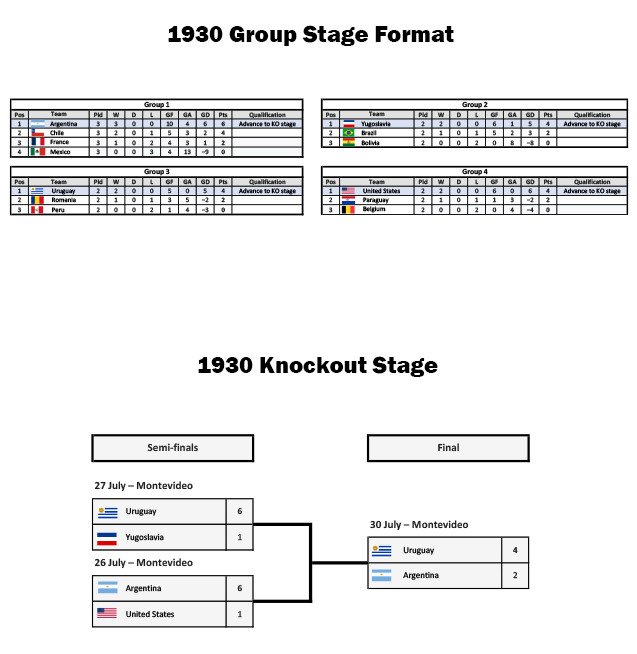
1930 – 18 Matches Played – Tournament Length (17 Days)
13 Teams – 1 Group of 4 and 3 Groups of 3 Teams
Each of the four group winners advanced to the semi-final knockout stage, with no third-place match being played.
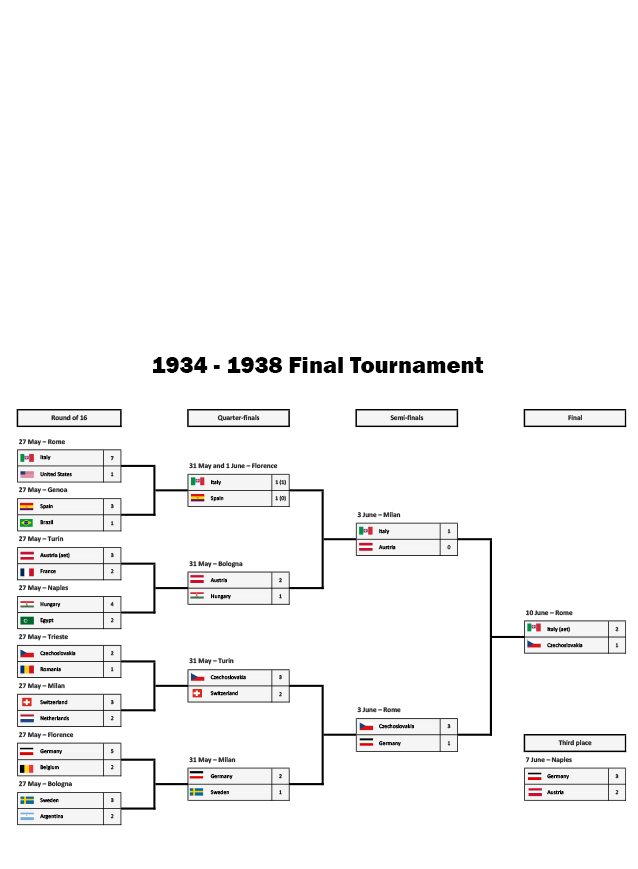
1934 – 1938 – 17 to 18 Matches Played – Tournament Length (14 to 15 Days)
16 Teams – Round of 16 Knockout Stage Tournament
For the 1934 and 1938 FIFA World Cup the group stage format used during the 1930 World Cup was abandoned for a round of 16 knockout tournament. If matches were tied after 90 minutes an additional 30 minutes of extra time was played. If the score was still tied after the extra time, the match would be replayed the following day.
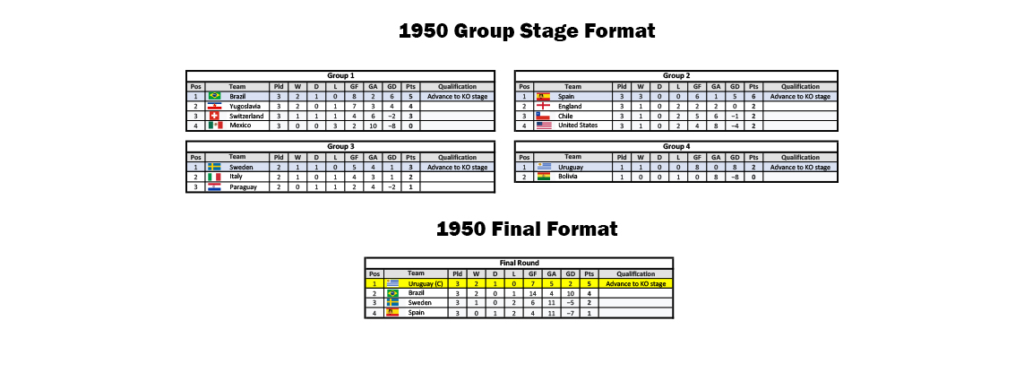
1950 – 22 Matches Played – Tournament Length (22 Days)
13 Teams – 4 Groups of 4 Teams, 1 Group of 3 Teams and 1 Group of 2 Teams.
In an effort to maximize the number of matches and ticket sales, the Brazilian organizers proposed that the 13 teams be divided into four groups, with the winner from each group advancing to a final group stage of four teams. This format would guarantee more matches for teams making the journey from Europe.
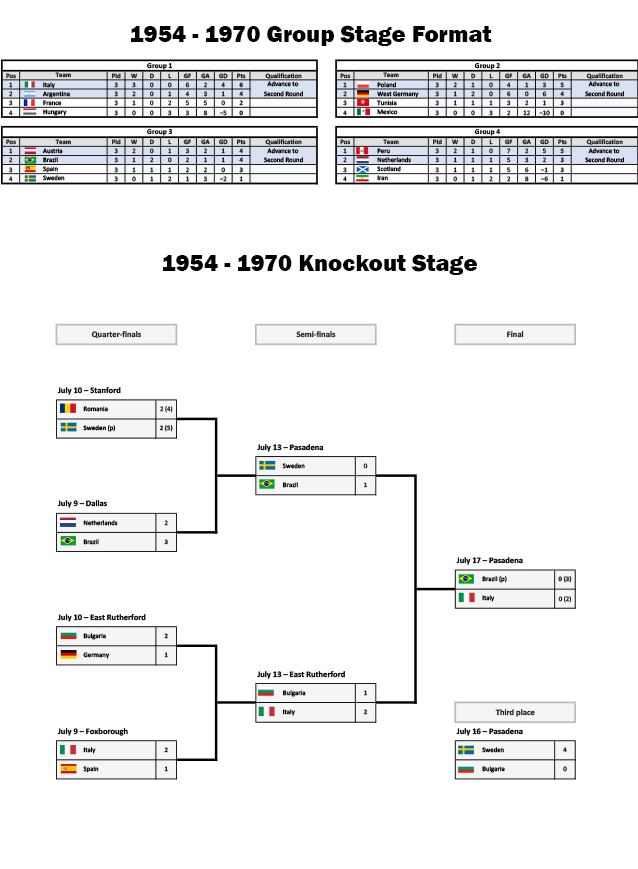
1954 – 1970 – 26 & 32* Matches Played – Tournament Length (18 to 26 Days)
16 Teams – 4 Groups of 4 Teams
While the 1954 tournament had 16 teams with 4 groups of 4 teams, each group had two seeded teams and two unseeded teams with the seeded teams only playing the 2 unseeded teams. Extra time during the 1954 World Cup was played during the group stage, which in most tournaments wasn’t the norm, but was used in 1954 if the teams were tied after 90 minutes.
For the 1958-1970 World Cups FIFA went back to more of a traditional format with the top two teams in each group advancing to the quarter-finals of the knockout stage but in the 1958 World Cup 3 playoff matches as tie-breakers to decide which second and third-place teams would advance out of the group stage. Going forward goal differential would be used as the first tiebreaker.
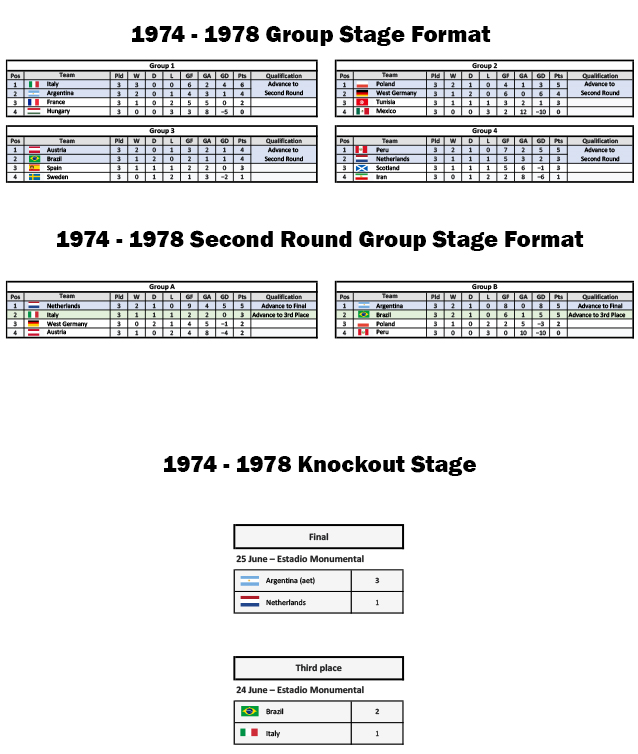
1974 – 1978 – 38 Matches Played – Tournament Length (24 Days)
16 Teams – 4 Groups of 4 Teams
The top two teams from each group advance to the second round and split into two groups of four. The winners of each group then play each other in the final, and the second-place finishers in the third-place match.
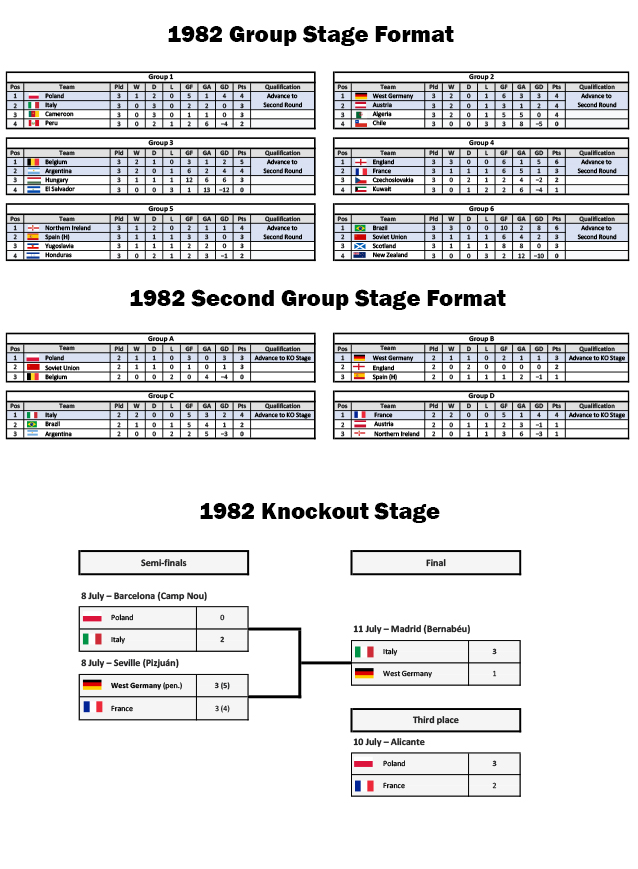
1982 – 52 Matches – Tournament Length (28 Days)
24 Teams – 6 Groups of 4 Teams
The top two teams in each group advance to the second round with the twelve remaining teams split into four groups of three teams each, with the winner of each group progressing to the knockout semi-final stage.
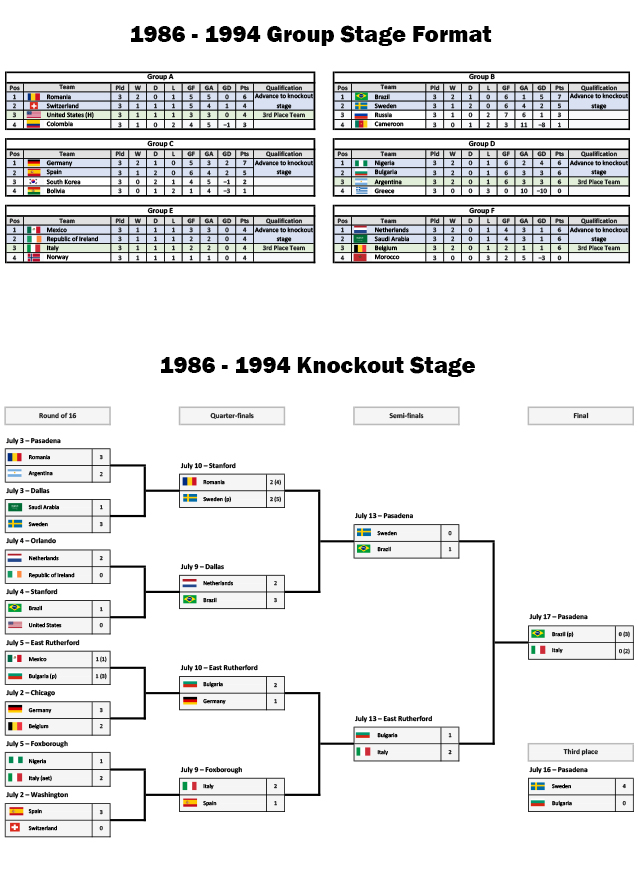
1986 – 1994 – 52 Matches – Tournament Length (29 to 30 Days)
24 Teams – 6 Groups of 4 Teams
The top two teams in each group advance with the four best third-place finishers from the six groups advanced to the knockout round of 16 teams.
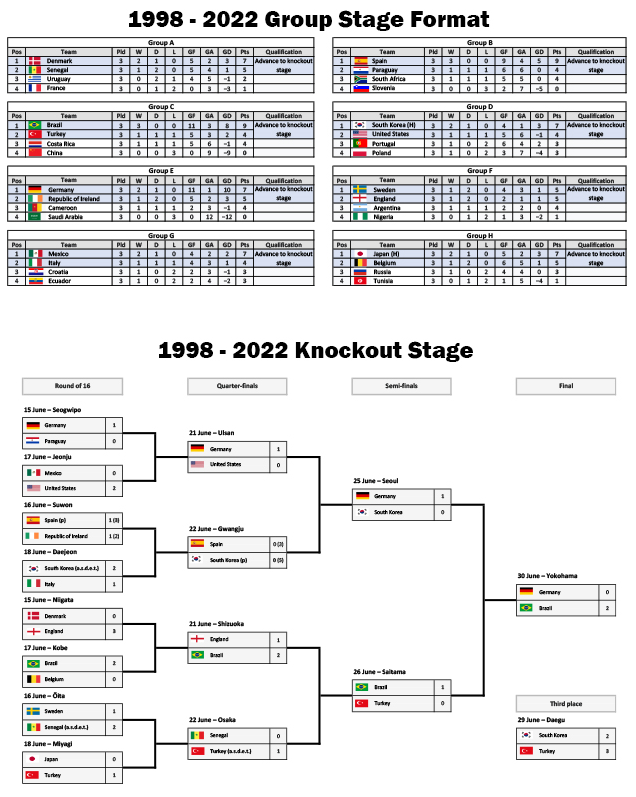
1998 – 2022 – 64 Matches – Tournament Length (28 to 32 Days)
32 Teams – 8 Groups of 4 Teams
About a month before the 1994 World Cup the international governing body voted in Zurich, Switzerland to expand to 32 teams from 24 starting in 1998 which would add an additional 12 matches to the tournament while generating more revenue. It would result in 8 groups of 4 teams with the top two teams in each group advance to a Round of 16.
You may like
Last year, I wrote a stock-up/stock-down article covering ten Americans who either made a move to Europe or to the U.S. We are closing in on New Year’s and about 6 months until the World Cup (June 11th, 2026), giving us enough data to know if these transfers have been beneficial not just for the players’ club careers, but to make it onto the USMNT for the World Cup. As American soccer players, this season is the most important season of their international career. The players are making one last argument for them to be at a USMNT camp and be part of the team when the United States of America co-hosts the FIFA World Cup. So far, a lot of the European transfers have not gone so well, compared to the domestic transfers.
*All information is up to date as of December 1st, 2025.
Yunus Musah to Atalanta (loan)- Stocks Down

When Massimiliano Allegri took over AC Milan, he cleaned house. Twenty-four players were permanently transferred out of the club or sent on loan (some for positive reasons and others, not so much). Yunus Musah happened to be one of those 24 players. AC Milan sent Musah on loan to fellow Serie A club, Atalanta, with an option to buy that is worth $28 million. As things stand, it does not look like Atalanta will trigger their buy option at the end of the season. Musah has only one start and has appeared in 9 matches (a total of 203 minutes) while being available for a total of 16 matches since joining the Nerazzurri. When it comes to goal contributions, Musah has only one assist coming from the Champions League match against Club Brugge. When it comes to passing, Musah’s accuracy has not been bad (83.5%), but he is lacking in chances created with only 3.
He has never been known for scoring goals, but his total shots this half of the season are as low as 0.6. As for his defensive work, it has been average. He has only 2 interceptions, has lacked successful tackles (25% success rate at 1/4), and he has committed a penalty. The only positive is his ball recovery rate, which is at 16. Statistically, the only areas where he sees positive results have been in his dribbling (60% completion) and duels won (59.5%). From Atalanta’s standpoint, if he is offering little in the final third and in your defensive half, then what is the purpose of starting him? As for the USMNT, his poor form at his club has not gone unnoticed by Mauricio Pochettino. The last time Musah received a call-up to the USMNT was for the Gold Cup, which he turned down and that could be a contributing factor to why he has not been called up since. Others in the midfield, and at right wing, have been able to stake their claim onto the team. At this point, we will not be seeing Yunus Musah make it onto the 26-man team this coming summer.
Johnny Cardoso to Atlético Madrid- Stock Down

One of the biggest transfers this past window for an American, and one of the closest followed transfers in Spain, was Johnny Cardoso’s $35 million (according to Goal) move to Atlético Madrid on a 5-year deal. Johnny was coming off a solid season with Real Betis that showed a promising career in Europe. He collected 4 goals and one assist as a defensive midfielder. In just two months of being at Real Betis, Johnny won the LaLiga U23 Player of the Month for February 2024. Fast forward to today, due to his lack of opportunities with Atleti and his USMNT form, his hopes of being at the World Cup are fading.
During pre-season, he made his way onto the starting XI for Atleti starting in the first three matches of the season. Sadly, he picked up an ankle injury that led him to miss 9 matches. Since returning on September 13th, 2025, Johnny went 5 matches without receiving a single minute. Diego Simeone has opted to go with veteran player, Koke, to start alongside Pablo Barrios and Conor Gallagher as the substitution. He finally got his chance when Simeone named him on the Starting XI in their UCL match against Inter Milan on November 26th, 2025. For someone who had not played a single minute since August, Johnny had a good game in the 59 minutes he received. When we look at the stats from those four matches, there were positives. His pass accuracy sits at 77% with 62% total duels won. Johnny also completed 67% of his dribbles, had 4 interceptions, 2.65 tackles per game, 9 clearances, and 9 balls recovered. Obviously, stats alone will not keep you on the pitch and the performances of the other midfielders as of late have made it difficult for Johnny.
Atleti fans on social media are happy with his performances, believe he should be a starter, and believe he is an important player to the team. Time is running out for him at the international level though with the final USMNT friendly camp coming up in March. He must make an argument for himself to get into that camp to get one last shot at the World Cup. If Johnny builds on his performance from the Inter Milan match, he could see himself in that final camp.
Paxten Aaronson to Colorado Rapids- Club: Stock Down

This will be seen as controversial by many MLS fans, but Paxten receives a stock down mostly because the move has not improved his chances of making it onto the USMNT and the impression that his career has regressed. Eintracht Frankfurt’s sporting director, Timmo Hardung, said, “With a view to the 2026 World Cup, which is taking place in his home country, among others, he made the request to take his next step at the Colorado Rapids.” During the Gold Cup, we saw 16 MLS players take part in the campaign. Paxten only received 58 minutes in total, when you include the friendly against Switzerland. It was the only camp he was called up to in 2025. We saw the likes of Diego Luna, Brian Gutierrez, Jack McGlynn, Luca de la Torre, and Sebastian Berhalter were either getting called up ahead of him and/or receiving more minutes than he was at the Gold Cup.
It set a precedent that no matter how well you perform in a top seven league, like the Eredivisie, the performance of those in the MLS will outweigh yours. In Paxten’s case, he had 8 goals and 4 assists in 30 starts for Utrecht, helping them finish 5th in the top Dutch league. His performance at Utrecht was enough for him to be part of Eintracht Frankfurt’s 2025/2026 campaign, who is competing in the UCL, part as stated by Hardung, Paxten submitted a transfer request to join Colorado Rapids. Yes, Paxten is getting regular minutes at Colorado instead of being a bench player, but he is coming back to MLS after just 2 ½ years in Europe. Despite receiving 571 minutes, Paxten only scored one goal and got 0 assists. It was not enough for Poch to give Paxten another chance with the USMNT, and the transfer had been all for nothing.
Malik Tillman to Bayer Leverkusen- Stock Up

Three seasons ago (the 2022/2023 season), Malik Tillman left the Bundesliga after agreeing to a loan deal to Rangers F.C. from Bayern München. For the following season, Tillman went on loan to PSV Eindhoven, which became a permanent deal. This season, he is back in the Bundesliga, but this time with Bayer Leverkusen. In his debut match for Die Werkself, he scored a goal at the 35-minute mark. It has been a slow start for Tillman in the G/A department with only 3 goals in 12 matches, but there are still many positives to this move that show he can make it in the Bundesliga. When available, Tillman started in 10 matches, 3 of which have been UCL matches, and a total of 815 minutes played. Right now, Tillman has 1.50 xG in the Bundesliga with 187 goals per minute.
He also has a goal conversion of 25% to add on top of that. Outside of scoring, his pass accuracy is at 85%, but he has 0 assists and only 6 chances created. Defensively, Tillman has intercepted the ball 8 times, recovered it 33 times, 3 blocked shots, and has a success rate of 79.9% (18/24) tackles. Additionally, he has won 50% of his duels. A major reason why Tillman gets a stock up is because of one reason, he is playing consistently at a high level. Diego Luna is in the MLS and towards the end struggled with his production (it also did not help when Tillman looked like the better 10 in the Gold Cup).
Paxten would not be a starter for Eintracht Frankfurt if he had stayed and he took a step backwards. Gio Reyna is in the Bundesliga as well and is one of our most talented players, but he only has 189 minutes for Mönchengladbach. Despite Tillman’s continued issue of performing consistently, the fact he is getting regular minutes at a top five league club and finally performing for the USMNT, has locked him in as the #1 CAM for the U.S. at the World Cup.
Damion Downs to Southampton- Stock Down

Damion Downs scored 2 goals in 179 minutes just shy of turning 20 years old. He followed this up with 10 goals and 3 assists in his first full season in a professional league when FC Köln was relegated to the 2. Bundesliga. FC Köln won the league and with-it promotion back into the Bundesliga. Downs contribution to the campaign got him a move to English Championship club, Southampton. Anyone who understands English football and Southampton’s striker depth knew this was a risky move. Prior to Downs joining, the club had Cameron Archer, Adam Armstrong, and Ross Stewart. So far, the transfer is going poorly and that is disappointing for a promising player. In 395 minutes, Downs has only one assist and gone 2 matches as an unused substitute. To make matters worse, he has only been on the matchday team sheet 16 times out of the possible 21 matches (Downs missed one match due to illness).
This move was not only important for Downs’ domestic career, but also his international career. During the 2024 Paris Olympics, Downs tried out for the U.S. Olympic team, but Marko Mitrović cut Downs from the team just before the Games. This led him to join Germany’s U20 to take part in their U20 Elite League campaign. It took Pochettino to give him an opportunity at the 2025 Gold Cup for Downs to rejoin the U.S. The goal for Downs would be to take that third striker spot with the USMNT this coming World Cup. Looking at his club form, that will not happen.
If you are looking for any positives, there are two. One, Downs is only 21 years old, so there is still plenty of time to recover his domestic career. Second, Downs is not the only striker at Southampton that has been struggling. Ross Stewart and Cameron Archer only have 2 goals, and one assist each this season. There is still the second half of the season to recover to possibly slide into the 2026 World Cup roster. If not, there is still the 2030 World Cup, which he will be 26 years old.
Patrick Agyemang to Derby County- Stock Down

When the Gold Cup campaign began, Patrick Agyemang started all but one match, when you included the two friendly matches. Prior to the Gold Cup, Agyemang was part of ‘Camp Cupcake’ and the Nations League finals in March. In the three camps, he scored five goals. Many fans and pundits were calling him to be a lock for the USMNT and that appeared to be certain after the Gold Cup, but that is where it ended for him. For the September camp, Folarin Balogun, Josh Sargent, and Damion Downs were selected over Agyemang. Hope returned when he was called in for the October camp, but he did not receive a single minute in the two matches.
Then came the November camp where he did not get the call from Pochettino. What could have happened that led him to fall out of favor with Pochettino? There are two reasons: Balogun and Pepi have returned from injury, and Agyemang has been in poor form at Derby County. In 11 starts and 953 minutes played, Agyemang has only 3 goals and 3 assists. In comparison, fellow American and Championship player, Haji Wright has 9 goals and 2 assists in 14 starts. To make matters worse, Agyemang has 318 goals per minute, and his goal conversion is a meager 11%. His passing has not been the greatest sitting at 69% accuracy, but Agyemang is just short of creating a chance per game at 0.9 (13 chances created). Besides having a poor goal conversion rate, his ball retention is also poor. Agyemang has lost 66% of his duels and losses possession 11.2 per game.
Before his move to Derby County, Agyemang scored 8 goals in the current MLS season and finished last season with 10 goals. The move has not only been a stock down for him domestically, but also internationally. Agyemang needs to find his form quickly or he will not be part of the USMNT again this World Cup cycle.
Benjamin Cremaschi to Parma (loan)- Stock Down

Benjamin Cremaschi was someone whose chances of making it to the World Cup were slim, but he took part in ‘Camp Cupcake’ and performed well in the U20 World Cup. Prior to the U20 World Cup, Cremaschi had yet to make his debut since joining Parma on loan at the end of the summer transfer window. After winning the golden boot at the U20 World Cup, Cremaschi got his debut, but he has only clocked in 14 minutes in 2 matches. On seven different occasions, Cremaschi has been an unused substitution by Carlos Cuesta. The loan deal includes a buy-option and so far, it does not look like Parma will exercise that option. Cremaschi needs to find his way on to the pitch to convince Parma to make the move permanent.
The move at first gave some hope that he could get back into the USMNT picture and his showing at the U20 World Cup reinforced that. Since he has not even reached 25 minutes in Serie A with barely any data and footage to go on, his chances at the World Cup are even less now. Cremaschi would have to try again during the 2030 World Cup cycle.
Timothy Weah to Marseille (loan)- Stock Up

Even though Tim Weah set a personal record for goal contribution with 10 goals and assists, he only started in 24 matches. Now, he is on loan where his dad spent a spell at Marseille. The loan has worked out for Weah so far, starting in 12 of the 15 matches he has appeared in. Currently, Weah has 2 goals and 2 assists with a goal conversion of 23%. His passing accuracy is at 87% with 15 chances created. Weah’s defense has been decent with 59.1% tackles completed, 35 recoveries, and 15 clearances. The one stat that has been negative for him is his duels at 50%, which is not too bad. The move back to Ligue 1 has been beneficial to not just his playing time, but more fitting to his playing style.
Weah is still in the USMNT picture and there should be no doubt that he will be at the World Cup. The question is, at what position? Weah has been playing all along the right side for Marseille, mostly at RB. Now that the USMNT is using a 3-4-2-1, Weah is fighting with Sergiño Dest for that starting RWB spot. If Pochettino does not plan to have Weah at RWB, does he move to CAM, where the depth is deep, or to striker? It is likely that Weah would be placed at RWB, but I do not think it is a matter of being #1 or #2. Depending on who our opponent in the World Cup is would decide if Poch starts Weah or Dest.
Kristoffer Lund to 1. FC Köln (loan)- Stock Up

A surprise transfer over the summer came from Kris Lund when he joined FC Köln in the Bundesliga on loan. Lund started off strong when he joined Palermo in Serie B back in 2023/2024, but last season he struggled with his form and getting starts (he only started 24 of the 35 matches he appeared in). That is why when the report broke out that newly promoted Bundesliga club, FC Köln, signed him on loan with a buy-option, it took U.S. fans by surprise. It has been up and down for Lund since joining Köln, but the club is midtable and will likely avoid relegation. Lund has also been starting consistently for Die Geißböcke with 10 starts out of 14 matches. Due to him getting consistent starts for a midtable Bundesliga club, many USMNT fans have suggested that Pochettino should give Lund another chance.
That has not happened, either because there is something about his club performance that has not impressed Poch to call him up over John Tolkin and Max Arfsten, or Lund’s performance back in the October 2024 camp that left a bad impression. Looking at his stats, Lund has not really done anything offensively and that could be a reason why he has not gotten another look by Poch. His xG is at a low of .20 while his xA sits at .41. Lund did get his first Bundesliga assist recently in Köln’s match against Werder Bremen. Lund’s passing has not been too bad with an accuracy of 72.5%, but his chances created are only at 6. Defensively, he is doing better where he has 10 interceptions, 95.8% (9/12) completed tackles, 31 recoveries, and 36 clearances. A major negative in his records is that he has committed two penalties.
The loan has been good for his domestic career and caught the attention of USMNT fans again. If we are giving a midtable 2. Bundesliga player call-ups, then a midtable Bundesliga player should get another opportunity. It is doubtful that Lund will be at the March camp and at the World Cup. The LWB position will likely be covered by Antonee Robinson and Arfsten, one who has been reliable for us since the 2022 cycle and the other who has a 6 G/A this year. He is 23 years old, so there is always the 2030 World Cup. Lund simply needs to end the season on a positive note, make his move to Köln permanent, and then perform consistently throughout the next cycle.
Honorable Mention
George Campbell to West Brom Albion- Stock Up

Another surprise transfer was when George Campbell left Montréal for English Championship side, West Brom. So far, it has not gone too badly for him. While healthy, he has started in 13 matches with a total of 1,259 minutes. Campbell has collected 2 clean sheets with 9 interceptions, 81.94% (21/30) successful tackles, 47 recoveries, 73 clearances, and 8 blocked shots. The only major negative defensive stat Campbell has is committing one error that led to a shot. He has been successful with his passes by completing 89% of them, but Campbell’s duels have been average, winning 50% of all duels.
Like Lund, Campbell recently got his first English Championship assist in West Brom’s clash against Swansea off the bench. Due to the USMNT’s current lack of quality CBs, there were fans suggesting that Pochettino call up Campbell to give him a shot. The thing is though, Campbell has mostly played at RB, a position that is covered by Sergiño Dest, Alex Freeman, and Joe Scally. On the upside, Poch has moved to a back 3, which could give Campbell access to the USMNT. It is doubtful that he will get a chance at the March camp, but he is only 24 years old, and he is now in Europe where he can continue to develop. The 2030 World Cup is still a reality and that is why he gets a stock up.
USL made national headlines when they announced on February 13th, 2025, their plans to launch a Division One league, followed by the announcement of promotion/relegation on March 19th for the new Division One league, the Championship, and League One. If sanctioned by US Soccer, USL Division One would be of equal status to MLS and compete for the best major soccer league in the U.S. The implementation of promotion/relegation in the USL would become the first in the U.S. and test the question asked for many years, “would pro/rel work in the U.S.” USL HQ informed the public that they planned to have the inaugural season of Division One during the 2027-2028 season with promotion/relegation beginning in 2028.
Until November 3rd, with the announcement of Tony Scholes being hired as the President of the Division One, only three teams have applied for membership to the inaugural season of Division one: Louisville City, North Carolina FC (who announced at the time of the Scholes news that they would fold until the launch of Division One), and Pittsburgh Riverhounds. There has been a rapid expansion of teams in the already existing leagues since the two announcements. Teams joining League One are: Fort Lauderdale FC (2026 debut), New York Cosmos (2026 debut), Port St. Lucie SC (2027 debut), Sporting Cascades FC (2026 debut), and Rodeo FC (2027 debut). Fort Wayne FC and Sarasota Paradise would also be joining League One from League Two (2026 for both teams). For the Championship, Reno, NV will once again have a team planned for a 2027 debut. Along with those teams, USL is actively working to expand to other markets. The markets and partners they are looking at are Brevard County, FL (Space Coast Pro Soccer), Riverside, CA (Riverside Pro Soccer), Brownsville, TX (City of Brownsville), Winter Garden, FL (Central FL Pro Soccer), Santa Rosa, CA (City of Santa Rosa), and Pensacola, FL (City of Pensacola).

Along with these recently announced teams and partnerships, USL has teams joining the organization just in time for promotion/relegation that were announced prior to the February and March news. Starting with League One, these teams include: Corpus Christi FC (2026 debut) and Athletic Club Boise (2026 debut). As for the Championship, they will be adding Brooklyn FC (2026 debut), Sporting Jax (2026 debut), Atlético Dallas (2027 debut), Milwaukee Pro Soccer (TBD), USL Pro Iowa (TBD), Buffalo Pro Soccer (TBD), and Ozark United FC (2027 debut), while Santa Barbara Sky FC (2027 debut) would replace Memphis 901 FC.
Other than that, news on the Division One and promotion/relegation had been quiet until USL snatched Tony Scholes from the English Premier League. Tony Scholes will be the President of Division and help with the implementation of promotion/relegation. Scholes served as the chief football officer of the EPL and will join USL at the end of the EPL season. As of November 15, 2025, USL Division One has not been sanctioned as a division one league by US Soccer. The hiring of Scholes indicates that they are confident this new league will get approved or they have already been told it will, behind closed doors. The fact that we have not heard news on what the promotion/relegation format would be, and Scholes task would be to help implement it could mean that USL has not come to a decision on one. Since we do not have any ideas on what the format could be, I want to provide a possible option that they could go with.

One of the biggest questions people have had since the USL announced promotion/relegation was how they would tie it to the playoffs. There is an option they could do, but it would result in only having one playoff. USL would have a playoff for Division One, but they would eliminate the concept for the Championship and League One. It might not be the most popular idea here in the U.S., but the main goal for the lower leagues is to get promoted, not to win a trophy. They would retain the league title for those two leagues with the winner being the team with the most points at the end of the season, just like how it is in the European leagues. The purpose is to create fairness for the top performing team(s) in the two lower leagues and reduce confusion. If there is a need for a playoff format, they could adopt the format the Bundesliga uses where the 16th best team in the first division and the 3rd best in the second division face-off in a two-leg match to see who would be in the first division the following season. The other option is the Championship concept, where the teams who finished 3rd through 6th in the table compete in a promotion playoff. The semi-finals are two-leg matches while the final is a single-leg match. The winner is promoted to the EPL. The execution of promotion/relegation must be done perfectly to retain fans, gain fans, prevent confusion, and be entertaining.
USL already has a division one league with their women’s Super League, who is competing against the NWSL. Currently, the S League has only nine teams (Brooklyn FC, Carolina Ascent FC, Dallas Trinity FC, DC Power FC, Ft. Lauderdale United FC, Lexington FC, Spokane Zephyr FC, Sporting Jax, and Tampa Bay Sun FC) to the NSWL’s 14 teams (3 teams in the works). The Super League will be adding an additional nine teams (Athletic Club Boise, New York Cosmos, Ozark United FC, Buffalo Pro Soccer, Chattanooga Red Wolves FC, Forward Madison FC, Indy Eleven, Oakland Soul SC, and USL Palm Beach) with all but three to have their inaugural season to be determined. What makes the S League unique from the rest of the soccer leagues in the U.S. is that they use a fall-summer schedule. Competing against a top five women’s league in the world is a tall ask, but it shows the ambitions of USL.
They are also willing to take risks by voting to pass promotion/relegation for the men’s league and have a fall-summer schedule for the S League. If the S League schedule format proves successful, it stands to reason that they would move the men’s leagues to the same schedule. It would also avoid the organization from having to fight MLS for viewership when the leagues are in play, especially when they launch a direct rival and are at their most ambitious point in their history. The same can be done for the S League if promotion/relegation is successful for the men. USL can start establishing lower women’s leagues and introduce promotion/relegation to the women’s game here in the U.S.
Many would say USL still stands no chance at competing against MLS, even with promotion/relegation and having a division one league. That is the case when you look at the quality of the players is finance, but that is the reason why the USL made these decisions based on the reports prior to the announcements and afterwards. Promotion/relegation and the introduction of a division one league could see an increase in investors. We are already seeing that with the likes of Gio Reyna joining Fort Lauderdale as an investor, BellTower Partners investing into USL, Sofia Huerta and Kasey Keller joining the Athletic Club Boise ownership group, and the Chickasaw Nation becoming an investor of the OKC for Soccer just this year alone. Then there is the expansion fee for MLS, MLS Next Pro, and the USL leagues. MLS charges an astounding $500 million! Yes, the money is used to construct a proper stadium, acquire players, etc., but at this point it will discourage many from purchasing a franchise license. MLS currently only has two leagues and one of them is advertised as a development league to prepare for MLS. The expansion fee for an independent team to join MLS Next Pro is unknown, but Sports Business Journal reported in 2024 that it is significantly cheaper than the USL Championship. The fee to join the USL Championship is $20 million while League One is only $5 million. These two fees are significantly lower than MLS and that will be more appealing to potential owners, but unlike the MLS fee, it is not enough for a stadium, training grounds, and players. As for what the fee is to join USL Division One, that is unknown at the moment.
I highly recommend reading the ESPN article by Jeff Carlisle titled “Will USL’s Move to Pro-Rel Change U.S. Soccer, Threaten MLS?” In there, Carlisle discusses the reasons behind the decision and that it is mostly financial. For example, a USL spokesperson said they expect to see an increase in commercial revenue by 15% to 30% due to promotion/relegation. Also, the former owner of San Diego Loyal lost $40 million in 4 seasons. As for the reaction from MLS, we have not heard one yet. The only possible reaction we have seen from them is what the former MLS Next Pro president, Charles Altchek, told to Backheeled back on March 6th, 2025. In the interview, he told them they aim to have 40 to 50 teams and a possible second league with one of the MLS Next Pro leagues being a second division, putting it in direct competition with USL Championship. The biggest question is, whichever league that is, can compete for fans? Due to the Apple TV deal, we currently do not have the ratings of MLS Next Pro. The closest idea we have is the attendance, which is 5,580 for USL Championship per match to MLS Next Pro’s 3,361, according to Transfermarkt. Unlike the attendance, the viewership for USLC is much higher where the season premiere match had 453,000 viewers. MLS Next Pro’s massive expansion plan announcement date was either a coincidence, or MLS got word USL’s promotion/relegation implementation with the division one news, and this was their response. I will let you come to your own decision.
It seems, as of right now, it appears MLS will sit back and wait to see how the USL’s Division One and promotion/relegation will play. Division One and promotion/relegation will either be successful for USL and lead them to the financial success they are hoping for or lead to the possible collapse of USL. American sports fans are not the only ones keeping their eyes on USL now, but the rest of the soccer world is after their two massive news. The coming years are going to be exciting times for American soccer!
From Maradona to Messi: A Quick Look at World Cups 1986–2022
Thomas Deschaine (@uskeeper on X and us_keeper on Instagram)
A quick look back at the last ten World Cups reveals how the world’s greatest sporting event has evolved and grown through the decades. With over 200 days until the 2026 FIFA World Cup kicks off, here’s a high-level recap of the tournaments that shaped its legacy, and a glimpse of what’s next.
1986 – Mexico

Diego Maradona delivered a World Cup for the ages, scoring both the “Goal of the Century” and the infamous “Hand of God” in the same match, then leading Argentina past West Germany to claim their second World Cup title.
1990 – Italy

The USA returned to the World Cup after a 50-year absence in what became the lowest-scoring tournament in history, as West Germany edged Argentina 1–0 on a late penalty. It marked West Germany’s final World Cup before reunification.
1994 – United States

The USA hosted its first-ever World Cup, setting all-time attendance records as Brazil defeated Italy in the tournament’s first final decided by a penalty shootout in front of the largest crowds in US since the 1984 Olympics.
1998 – France

FIFA’s first 32-team World Cup saw host nation France capture its first-ever title, becoming the seventh country to win the trophy. Led by Zinedine Zidane triumphed on home soil with a commanding victory over defending champions Brazil.
2002 – South Korea/Japan

The first World Cup with co-hosting nations saw South Korea stun many by reaching the semifinals, while Brazil claimed their fifth title, powered by Ronaldo’s two goals in the final against Germany.
2006 – Germany

Germany came up short on home soil, losing in extra time to eventual first-time finalist Italy in the semifinal. Italy went on to claim its fourth World Cup, edging France on penalties in a final forever marked by Zidane’s infamous headbutt in extra time.
2010 – South Africa

The first World Cup hosted by a CAF nation, South Africa, saw the host nation become the first ever to fail to advance past the group stage. Meanwhile, Spain captured their first World Cup, showcasing their tiki-taka mastery and defeating the Netherlands in extra-time with Andrés Iniesta’s decisive goal.
2014 – Brazil

Host nation Brazil reached the semifinals on home soil but suffered a shocking 7–1 defeat to Germany and then fell 3-0 to the Netherlands in the third-place match. Germany went on to defeat Argentina in extra time, with Mario Götze scoring the decisive goal, while Lionel Messi claimed the Golden Ball as the tournament’s best player.
2018 – Russia

France’s golden generation, spearheaded by tournament Best Young Player Kylian Mbappé, captured their second World Cup title with a thrilling 4–2 victory over Croatia, led by Golden Ball winner Luka Modrić.
2022 – Qatar

The 2022 World Cup, overshadowed by controversies over migrant worker treatment and extreme heat, which pushed the tournament to November and December, ultimately delivered a historic finale. Lionel Messi achieved crowning glory as Argentina triumphed on penalties in a thrilling 3–3 final against France, highlighted by Kylian Mbappé’s hat-trick.
2026 – United States/Mexico/Canada
The 2026 World Cup will feature a major expansion from 32 to 48 teams and, for the first time ever, be hosted by three nations. Mexico will make history as the first country to host matches in three different World Cups, while the United States becomes the sixth nation to host at least twice. What unforgettable moments will define this landmark tournament?
2025 Summer Transfer Window Review
USL’s American Soccer Dream
From Maradona to Messi
Trending
-
Club News1 year agoAmerican Transfers: Stock Up & Stock Down
-
USMNT2 years agoUSMNT Kits Come in Different Styles and Colors
-
Club News6 years agoJulian Vincente Araujo
-
Club News5 years agoCJ dos Santos, Benfica
-
USMNT5 years agoA Hidden Gem: Barça Residency Academy
-
USMNT2 years agoIs the MLS Specifically Targeting Expansion to USL Cities?
-
USMNT6 years ago
MLS Quota
-
MLS3 years ago2022 Youth Series: MLS Club Youth Talent Rankings