USMNT
World Cup Positional Depth Chart
Published
4 years agoon
Introduction
Welcome to my World Cup Positional Depth Chart, a tier list I’ve worked on for 2 months that sorts the best players for all 32 teams into various tiers based on a rough approximation of how good the “best” players for a nation are.
I’ve sorted the best players from every NT’s player pool into 6 positional groups(or PG’s): Centerbacks, Midfielders, Wingers/Second Attackers, Fullbacks/Wingbacks, Strikers, and Goalkeepers.
Players are tiered based on the average “goodness” of their countries’ best players at a specific PG. This means that a Tier 1 level midfielder can be sorted into a lower tier if his national team’s other first choice mids aren’t as good.
Each National team has 11 players sorted into tiers. The distribution of these players for each PG is determined by the formation each National Team typically uses. For example, if a team typically uses two midfielders, that team’s two best midfielders will be sorted, collectively, into a tier. If a team typically uses three center backs, then their three best center backs will be ranked collectively. In cases where a National Team is using various formations interchangeably, I’ll choose one that allows for more talent to see the field. In cases where there’s a coaching change, lineups after the coaching change will be prioritized as reference.
As a bonus, I have ranked players from the United States Men’s National Team who aren’t necessarily “first-choice”.
What This List is not
This is not a measure of how effectively players for different national teams mesh with each other. This is also not an assessment of potential; “Talent” or “goodness” here is simply how good a player currently is. This also isn’t definitive, it’s meant to be a conversation starter; disagreement is encouraged.
Criteria
For this project, a player’s “goodness” is determined by their hypothetical impact on winning in various situations. To estimate how good each player is I’ve considered the following criterion:
- Current Value
- Team Performance (domestic and international)
- Strength of Competition (league quality is approximated based on various metrics including, but not limited to, national team representation, Gfl rankings, Transfermarkt valuations, average wage, ect.)
- Minutes Played (adjusting for physical availability)
- Impact (Does a player’s presence correlate with improved team performance? Overperformance of expectations? Stronger defensive performance?)
- Market perception (who’s tried to buy a player, team’s valuations, ect, ect.)
- Historic Value (Class over Form)
- Team Performance
- Strength of Competition
- Impact
- Minutes Played
- Accolades
- Recency
- Age/Health
- Data
- Eye Test/Film-Tracking
- Granular Metrics (g/a, chances created, post-shot xg, ect.)
- Holistic Metrics (G+, IMPECT, ect)
- Underlying Metrics (xG, xA, xT, ect.)
- Clutchness
- Performance in big games (club or country)
- Performance against better competition (club or country)
- Team Context
- Stylistic Fit
- Distribution of “goodness” (Ex: Dortmund are disproportionately weak defensively while Crystal Palace are disproportionately strong defensively)
- Versatility (How has a player’s value performance/value translated in various situations/roles)
With that out of the way…
World Cup Positional Depth Chart
Goalkeepers
Tier 1
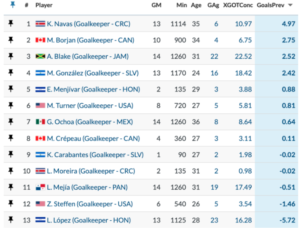
Courtois, Allison or Ederson, De Gea, Neuer, Navas
Tier 2
Lloris, Musso or Rulli, Pickford, Onana, Muslera, Smhiechel, Sommer, Bonou, Patricio, Szczęsny, Mendy
Tier 3
Eliji Kawashinma, Beiranvand, Borjan, Rajković, Livaković, Krul, Ryan, Sad Al Sheeb
(Both Turner and Horvath go here)
Tier 4
Ochoa, Hennesey, Kim Seung-gyu
(Sean Johnson, Stefan Frei, Gaga Slonina, Brad Stuver, and Josh Cohen go here)
Tier 5
Attah, Galindez, Al-Owas, Mouez Hassen
(Zack Steffen goes here)
Notes
-> Keylor Navas and Jordan Pickford both get a “clutch” boost from disproportionately strong national team performances in WCQ and the Euros respectively.
-> Navas also gets a boost from “historic value”having arguably peaked as the best keeper on the planet. Going by recent club play Navas is not a “Tier 1” keeper, but the combination of maybe the most impressive carry-job from anyone in this cycle’s world cup qualifiers and a very impressive track record (for club and country) affords him some leeway.
-> Despite the relative weakness of the “Qatar Stars League”, Qatari keeper Saad Al Sheeb rides a decade of international success, a half-decade of domestic dominance, and a solid set of individual accolades (for both club and country) into Tier 3. Leagues are not monoliths. Between a 3rd place finish at the Club World Cup, an AFC Champions league win, and 3 league titles in the last four years, Al Saad has established themselves as a formidable force in Asia. At the heart of this success was Al Sheeb who has emerged as one of the continent’s most accomplished players.
Strikers
Tier 1:
Lewandowski, Benzema, Kane, Messi
Tier 2:
Ronaldo, Neymar, Lukaku/Origi, Werner/Havertz, David/Larin, Vlahovic, Depay, Suarez/Nunez
Tier 3:
Raul Jiminez, Poulsen, Bale, Nesyri, De Jong, Choupo-Mouting/Aboubakar, Dia, Kramaric, Azmoun/Taremi
(Pefok goes here)
Tier 4:
Asano, Ui-Jo, Khazri, Gyan, Embolo, Akim Afif
(Jesus Ferreira, Sargent, Wright, and Vasquez go here)
Tier 5:
Duke, Estrada, Al-Sheri, Ugalde
(Pepi, Hoppe, and Zardes go here with everyone else)
Notes
-> Ronaldo registers higher here than one might expect based on his recent form thanks to what he’s accomplished in previous seasons. With the Portuguese attacker reportedly pushing for a move in the off-season, I’m considering CR7’s production last season more relevant to assessing him than his goal-less start to this one. Rating Ronaldo is tricky as his granular production and impact signals don’t always line up; on one hand Ronaldo contributed to many goals(0.77 g/a per 90 in the league) for a disappointing United last season. On the other, United became disappointing after they signed him. I think fit is a large factor here (Ragnick is the father of Geggenpressing and Ronaldo, now in his 30’s, isn’t a forward you should be asking to running at defenders), but between United underperforming, his limitations (age-induced) in other facets of the game, and a goal-less start to 22-23, it’s hard to justify placing him at the top.
-> One might be tempted to bump Messi off Tier 1 due to diminished goal-scoring, a move to a significantly weaker league, and the myriad benefits that come when you play on a team that is much better than any of your (domestic) competition. On the other hand, Messi was one of the best creators in Ligue 1 last year(Top 5 in chances created, PPA, xA, assists, and progressive passes), scored at a high rate against elite European competition(5 goals in 7 games), and played a key role for Argentina in a Copa America win and an undefeated qualifying campaign against the most difficult qualification schedule in the world. Additionally, Messi significantly underperformed his xG last season(may just be a cold-streak) and his scoring has seemingly returned(to some extent) for 2022-23. All that considered, I still have Messi in the top tier of forwards.
-> American forward Pefok is tricky to assess for a number of reasons. For one, he’s disproportionately weak at non-scoring aspects at the game. For another his sample size against elite competition is incredibly small. Pefok has 7 g/a over 12 games in the last 2 seasons against teams in the top 4 leagues. Making this more impressive is that most of those goals and games came on a plucky Swiss underdog against teams good enough to qualify for European competitions. While very impressive on the surface, the exceedingly small sample size, and Pefok’s weaknesses in other aspects(significant enough that he’s been left out of several US camps entirely) cast some doubt on the reigning Swiss Super League golden boot winner. That said, Pefok was signed by and is currently starting for a Bundesliga team that finished 5th last year and has started the current campaign tied on points with Bayern. While Union are likely to regress, they’ve done enough with Pefok as a starter to solidify Pefok as a Tier 3 attacker.
-> Welsh Forward Gareth Bale and Mexican Forward Raul Jiminez stay in Tier 3 largely due to what they’ve done previously. Raul Jiminez was Wolves most valuable player when they were pushing for Europe in 2019-20. Bale earns leeway thanks to highs achieved with maybe the greatest club team ever(Bale played a significant role in Madrid’s remarkable Champions League three-peat) and two massive performances against Austria and Ukraine in one-off wcq playoffs to send Wales to their first world cup in 64 years.
-> Costa Rican forward Manfred Ugalde refused call-ups during WCQ saying he won’t play for “Los Ticos” as long as Luis Fernando Suarez remains coach. Nonetheless, since Manfred is the most promising Costa Rican attacker since Joel Campbell, is getting regular minutes for one of the best teams in the eredivisie, and his national team is bereft of decent alternatives, for the sake of this depth chart, Manfred Ugalde will represent the Ticos.
-> Having yet to earn a start, Canadian forward Cyle Larin isn’t having the best of starts at Club Brugge. Form, however, is not class and Cyle Larin’s recent track-record includes leading all players in wcq in goals, scoring the second most international goals in 2021, and leading the front-line for the most prolific offense in Super Lig history. With all that in mind, I’m giving Larin some benefit of the doubt.
Wingers/Second Attackers:
Tier 1:
Viniscus/Ralphina, Mbappe/Coman, Sterling/Sancho, Silva/Jota, Sane/Muisala, KDB
Tier 2:
Alvares/Correa, Pino/Olmo, Alphonzo Davies/Buchanan, Mane/Sarr, Wijnaldum/Klassen, Tadic
(Pulisic and Aaronson go here)
Tier 3:
Corona/Lozano, Son/Hwang, Perisic/Vlasic, Vargas/Shaqiri, Ito/Takumi, Zlenski/Syzmanski, Ayew/Paintsil, Ziyech/Amallah
Tier 4:
Olsen/Damsgaard, Rossi/Pellistri, Gholizadeh/Jahanbakhsh, James/Morrell, Ekambi/Hongla, Muwallad/Al-Dawasari, Leal/Campbell, Valencia/Plata
(Weah and Tilman go here with Tilman being interchangeable with Djordje Mihailovic or Paul Arriola)
Tier 5:
Haydos/Hatem, Mabil/Boyle, Msakini/Sliti
(Arriola and Morris go here with everyone else)
Notes
-> Canada is an example of how looking at the average “goodness” of a PG instead of how good the best player from a PG can lead to different results. Tajon Buchanan is a good player on a good team but I don’t see him as a peer of players like Sancho, one of Europe’s most prolific chance creators at 20 with Dortmund, or Jota, a first-choice starter for one of the most dominant club sides in history. Thus, Canada drop to Tier 2, even with maybe the best left-back on the planet in Davies.
-> While Davies usually plays as a left-back with Bayern, Canada usually plays him as an out and out attacker. Additionally, listing Davies as an attacker allows room for Canada’s other fullbacks on the field. Remember, this ranking prioritizes talent over fit.
-> Ghanian winger Joseph Plantsil has significantly upped his minutes for a Genk team that looks to be better in 2022-23 than it was in 2021-22. As a result my evaluation of Plantsil has improved lifting Ghana’s wingers from Tier 4 to Tier 3. Form may not be class, but it’s still something.
-> Serbia and Belgium mostly play with three center backs instead of two. The trade-off is they’re left with one second attacker instead of two wingers. For Belgium it’s creative maestro Kevin de Bruyne(KDB). For Serbia its savvy swiss army knife Dusan Tadic. PG classification doesn’t necessarily align with the specific function a player serves for their national team. Again, this ranking prioritizes talent over fit.
Fullbacks/Wingbacks
Tier 1:
Alexander-Arnold/Walker, Hernandez/Pavard, Azpilacueta/Alba, Danilo/Milatoa, Cancelo/Mendez, Kimmich/Gosens
Tier 2:
Tagliafico/Molina, Kostic/Zivkovic, Araujo/Oliveira, Sarr/Toure, Hakimi/Mazraoui, Thorgan Hazard/Meunier
(Sergino Dest and Antonee Robinson go here)
Tier 3:
Sosa/Juranovic, Larsen/Maehle, Arteaga/Sanchez, Gamboa/Matarrita, Preciado/Estupinan, Widmer/Rodriguez, Bereszyński/Cash, Wass/Maehl, Al Breik/Al Shahrani
(Joe Scally and Sam Vines go here with Vines being interchangeable with Yedlin or Henry Wingo)
Tier 4:
Mensah/Odoi, Tolo/Oyongo, Maaloul/Drager, Adekugbe/Johnston, Nagatomo/Yamane
(Deandre Yedlin and Henry Wingo go here with either being interchangeable with Reggie Cannon, Shaq Moore, John Tolkien, Kevin Paredes, and DeJuan Jones)
Tier 5:
Moharrami/Amiri, Ahmed/Ro-Ro, Yong-Lee/Kwin-Moon-Han, Atkinson/Behich, Robert/Williams
(Shaq Moore and George Bello go here with everyone else)
Notes
-> English right back Trent Alexander-Arnold(TAA) hasn’t been a first-choice starter for Gareth Southgate’s England. TAA has been a first-choice starter for a Liverpool side who’s current iteration has few historical peers. Trent has been Liverpool’s primary chance creator and a critical opponent for their attack. Trent has arguably been the best creator in England, leading the league in expected assists, chances created, and progressive passes; finishing second in assists and passes towards the 18(PPA), and finishing 8th in expected threat(xT). Considering that Trent is also a solid ball carrier and a decent(if not spectacular) defender, you’d be hard-pressed to argue TAA isn’t one of the best players around. While he may not fit into Southgate’s plans, TAA is, for my money, one of the best players in the world and therefore an easy choice for Tier 1.
-> Despite the relative weakness of the Saudi Professional League, Saudi right back Mohammed Al Breik, like many of his countrymen, rides the tide that is Al Hilal SC. Dubbed the “The Asian Galacticos”, Al Hilal hold a record 8 AFC Champions league titles(2 from the last 4 years), a record 18 Saudi Professional League titles(5 from the last 6), is ranked #1 in Asia by most ranking sites, and was voted as the “Best Asian Club of the 20th century” by IFFHS. Put simply, Al Hilal is the crown prince of Asian football, and Al Breik, a regular fixture since 2015, has shared in its glory. With two AFC Champions League wins, 5 Saudi Professional League wins, 2 top 4 finishes at the Club World Cup, a combined 13 major trophies in 9 years as a pro, and a spot in the IFFHS “AFC Team of the Decade”, Al Breik is a giant in Asian football. Saudi left back Yasser Al-Shahrani didn’t get a spot in the “AFC Team of the Decade” like Al Breik, but has won the same silverware as a fixture in Al Hilal’s lineup and has won nearly twice as many caps for his country. Together, they represent “The Green Falcons” at Tier 3.
-> While they only employ one player on this list, Egyptian powerhouse Al Ahly represents an even higher tide than Al Hilal. Besides winning a record 10 CAF Champions leagues(2 of last 3), 42 domestic league titles(13 of the last 15), and just about everything that can be won in African soccer(usually more times than anyone else), “The Red Giant” have been quite successful outside of Africa, running the the table on Afro-Asian competitions and earning three Top 3 finishes at the Club World Cup(including its last 2 iterations). Notably, in the last CWC, they thumped the “Asian Galacticos” 4-0 to clinch bronze. The year before, they took third via a penalty win over Copa Libertadores champion Palmeiras. With Egypt’s national team missing out on Qatar, Al Ahly has one representative for 2022: Tunsian left back Ali Malooul. A mainstay for “The Red Giant ” since 2016, Ali Malooul has been named to the CAF team of the year three times and has been involved in the most successful era for arguably the most successful club team outside of UEFA or CONMEBOL. The same cannot be said for Tunisian right back Mohamed Drager who was loaned to the nearly relegated FC Luzern after making one matchday squad for championship side Nottingham Forest and 2 appearances for Nottingham Forest’s u-21 team(Mohamed is 26). Thus, despite Ali Malooul’s accomplishments, Tusnia’s wide backs slot into tier 4.
-> Moroccan right back Noussair Mazaroui finds himself in the unfortunate position of his country’s best player, Achraf Haikimi, playing the same position on the same side of the field. Thus, he’s usually left out of the lineup while natural left back Adam Masina plays on the other side. However, as far as quality goes, becoming a first choice starter for Ajax, reaching the champions league knockouts, and getting minutes for Bayern while being a fixture in the matchday squad are all solid indicators. As this project prioritizes quality over fit, Mazaroui gets to line-up for “The Atlas Lions” here, even if he won’t do it in Qatar.
Midfielders
Tier 1:
Kante/Pogba/Nkunku, Rodri/Koke/Gavi, Gundogan/Kimmich/Goretska, Casemiro/Fabinho/Fred, Paul/Peredes/Rodriguez
Tier 2:
Moutinho/Fernandes/Palhinha, Bellingham/Henderson/Phillips, Bentancur/Valverde, Wijnandum/De Jong/Van de Beek, Modric/Brozovic/Pasali, Gueye/Mendy/Kouyate, Eden Hazard/Witsel, Hojberg/Eriksen
(Mckennie, Adams, and Reyna go here)
Tier 3:
Herrera/Alvarez/Guardado, Freuler/Shaqiri/Zakaria, Savic/Lukic/Gudelj, Lee Jae-Sung/Jeong Woo-yeong/Hwang In-beom, Partey/Baba/Kudus
(Musah can go here)
Tier 4
Eustaquio/Hutchinson, Kamada/Endo/Morita, Amrabat/Barkok, Moder/Bielik/Linetty, Romdhane/Laidouni/Chaalali, Caicedo/Franco/Gruezo, Kanno/Al-Najei/Al-Faraj, Ramsey/Allen, Mooy/Hrustic/Irvine
(Yunus Musah, Kellyn Acosta, and Luca de La Torre go here with Busio, Roldan, and Duane Holmes being interchangeable with all three)
Tier 5
Nourollahi/Ezatolahi, Oum Gouet/Onana, Borges/Tejeda
(Eryk Williamson, Alan Sonora, and Paxton Pomykal go here with everyone else)
Notes
-> Belgium, Uruguay, Cameroon, and Iran generally use an extra forward at the expense of a third midfielder. Canada has made substantial use of both two striker and one striker set-ups, but to keep the quartet of David, Davies, Larin, and Buchanan on the field. i’m choosing a two striker set-up at the expense of a third mid.
-> Denmark has 10 players on teams set to play in the 22-23 UEFA Champions league. Of those 10, 4 are first-choice starters and of those starters, 2 play for a club in the “big 4” leagues. One of these 2 is Tottenham midfielder Pierre-Emile Højbjerg. Unlike many of his countrymen plying their trade at higher levels, Hojbjerg hasn’t struggled for minutes, playing literally every minute for a Tottenham side that has started 2022-2023 undefeated. Additionally, Christian Eriksen has performed well since brushing with death at the Euros. Upon his arrival in 21-22, Brentford experienced an immediate uptick in form, going 7-3-1(W-L-T) with Eriksen on the field(they had a record of 5-15-6 without him). His heroics at West London earned him a move to the red part of Manchester where Eriksen has played 98% of available minutes for Manchester United. Combined, the improvement in play/team form for Hojberg and the successful return of Eriksen as a professional player elevates Denmark’s midfield from Tier 3 to Tier 2.
-> Morocco, Costa Rica, Wales, and Denmark lose a third midfielder in exchange for an extra center back. While Costa Rica has made substantial use of both two center back and three center back set-ups(alternating between an extra striker or an extra defender), they tended to use three center backs when facing more talented opposition. Since Costa Rica is less talented than their three group stage opponents, I’ve decided to go with the extra defender.
-> Wales’s World Cup squad is likely to feature the most lower division players, including Swansea City midfielder Joe Allen. His partner-in-crime is former Arsenal player Aaron Ramsey who’s presently struggling for starts at Nice; currently winless in Ligue 1. Wales are currently the second highest ranked team with a Tier 4 midfield per Elo(22), and the highest ranked team with a Tier 4 midfield per Fifa(19). Strategy can minimize weaknesses; by focusing on direct attacks and dropping their lines under pressure, Wales are able to shift the game towards their Tier 3 attacker and their Tier 3 defenders. Consequently, Wales have been able to make do with a relatively weak midfield corps.
Centerbacks
Tier 1:
Marquinhos/Silva, Verane/Kimpembe, Laporte/Torres, Diaz/Pereia, VVD/De Ligt, Rudiger/Sule
Tier 2:
Romero/Otamendi, Stones/Maguire, Christensen/Andersen/Kjaer, Koulibaly/Diallo
Tier 3:
Akanji/Schar, Alderweireld/Jan Vertonghen/Boyota, Gimenez/Godin, Lovren/Gvardiol, Saiss/Aguerd/Mmaee, Pavlović/Veljković/Milenković, Hincapie/Torres, Djiku/Amartey, Ben Davies/Ampadu/Rodon
(Richards, Ream and Brooks go here)
Tier 4:
Moreno/Araujo, Yoshida/Itakura, Glik/Bednarek, Ngadeu-Ngadjui/Castelletto, Al-Amri/Al-Bulaihi
(Walker Zimmerman and Erick Palmer Brown go here with either being interchangeable with Cameron Carter Vickers, James Sands, Miles Robinson, and Matt Mizaga)
Tier 5:
Kanaanizadegan/Khalilzadeh, Min-jae/Kyung-won, Talbi/Ghandri, Miller/Vitoria, Calvo/Watson/Vargas, Wright/Rowles
(Aaron Long goes here with everyone else)
Notes
-> It might be a surprise for some that John Brooks, who seems to have fallen out of favor with USMNT Coach Gregg Berhalter, is placed a tier ahead of various, recently capped, American center backs. However, this list prioritizes “goodness” over fit(or player-coach relationships), and between multiple seasons of strong play in the Bundesliga, being signed by by a reigning UCL Quarterfinalist, and an arguable “best player on the team” performance during the 2021 Nations League, I’m comfortable putting Brook’s roster snubs down to factors besides how good he is at soccer.
-> The going has been rough for Ecuadorian center back Piero Hincapie and Bayer Leverkusen; losing all but one of their first 5 games with Piero suspended for game 6. Form, however, is not class. Piero was a first choice starter for “The Company’s Eleven” as they made a surprise top 3 finish in the bundesliga last season. The going has been good for fellow Ecuadorian Felix Torres who’s Santos Laguna is currently top 4 in the standings for the Apetura. Together they slot into Tier 3 giving Ecuador 4 starters in roughly average territory. The other 7 have been slotted into tier 4 or 5 which is remarkable considering “La Tri”’s recent competitive performance: Ecuador were 3rd throughout most of CONMEBOL qualifying, only slipping to 4th when they were guaranteed a World Cup spot with games to spare, notched multiple results vs Brazil and Argentina, and are ranked 18th in elo which places them among 15th among teams referenced in this list. A team can be better than the sum of their parts and Ecuador have arguably gotten more out of their players than anyone else.
-> Significantly younger American center back Chris Richards also finds himself in a pickle, with 1 start for Crystal Palace through the beginning of 2022-23. While not the best of looks, context makes this more palatable. Crystal Palace are disproportionately good at the position of center back. While limited elsewhere, their center backs are elite by Premier League standards. Chris Richards locked in a starting spot with Hoffenheim last season as they pushed for Champions League qualification, has a statistically strong profile over multiple years in the Bundesliga, and was deemed valuable enough to Bayern that they set out a minimum fee of 20 million when Chris Richards insisted on a move. Ultimately Richards was too good for Bayern to let him go cheaply, but not good enough(yet) to be more to Bayern, one of the best teams on the planet, than depth. All considered, Richards is probably good at soccer. If things go well(say Richards becomes a starter at Crystal Palace and Brooks kills it with Benfica), 2022-23 might push the Yanks to Tier 2. If things go badly(say Richards stops getting playing time and Brooks is demonstrably out of his depth), they could drop to Tier 4. For now, with the World Cup fast approaching, they’ll have to settle for being middle-of-the-pack.
-> The going has also been rough for Senegalese center backs Kalidou Koulibaly and Abdou Diallo. The former has seen his team(Chelsea) sputter out of the gates while the latter has yet to see a single minute of action. Nonetheless, form isn’t class, and both centerbacks got significant minutes last season for two of the best teams on the planet. Even with 22-23 starting sub-optimally, it’s hard to put Senegal’s duo lower than Tier 2. This leaves all of Senegal’s starters, save for Tier 3 striker Boulaye Dia, at Tier 2 with certain individuals, like Mane, being worthy of Tier 1. With 1 player in average territory and the rest ranging from good to world-class, Senegal’s recent competitive performance is remarkably…disappointing. With losses to sides like Egypt and Zambia, and a plethora of non-wins against sides like Togo, Guinea, and Malawi, Senegal are ranked 47th according to Elo, which puts them 28th among teams on this list. A team can be less than the sum of their parts and Senegal have arguably gotten less out of their talent than anyone else.

You may like
USMNT
The Next USMNT Star That Never Was: Revisiting America’s Biggest Teenage Prospects
Published
5 days agoon
September 25, 2026
Thomas Deschaine (@uskeeper on X and us_keeper on Instagram)
With the next wave of highly rated teenagers likely to be brought into the #USMNT during the 2030 World Cup cycle, I decided to look back at some of the young players who were once hyped as the next stars of the U.S. Men’s National Team but never established themselves as regular internationals.
Freddy Adu would seem to be at the top of this list. While he never became a regular for the #USMNT or the world-class face of U.S. Soccer many expected, he still earned 17 caps, scoring 2 goals and adding 3 assists. In many ways, he accomplished more at the international level than most of the players who are listed below combined.
Which former USMNT prospects did I miss, players who are no longer playing or are past their prime, who deserve to be on this list?
Cody Cropper – GK – 0 caps
U.S. youth international and longtime goalkeeper prospect who reached the Southampton and MLS systems but never earned a senior cap.
Junior Flores – AM – 0 caps
Creative midfielder who joined Borussia Dortmund’s system as a teenager and was viewed as a major U.S. prospect, but never reached the senior USMNT.
Eddie Gaven – MF/W – 8 caps
Teenage MLS phenom who became a league standout, but despite eight USMNT appearances, his international career never developed further.
Luis Gil – AM – 2 caps
One of the most hyped American midfield prospects of his generation; debuted for RSL at 16 but never translated that promise into a sustained USMNT career.
Emerson Hyndman – MF – 2 caps
Highly rated central midfielder who broke through at Fulham and earned two USMNT appearances, but never established himself internationally.
Perry Kitchen – DM/CB – 5 caps
U.S. youth captain and defensive midfielder who became a regular MLS starter, but his senior international career stalled after five caps.
Will Packwood – CB/DM – 0 caps
Birmingham City prospect who became the youngest American to play in the English Championship, but injuries severely disrupted his development.
Marc Pelosi – LB/CB – 0 caps
Highly regarded defender who moved to Liverpool as a teenager, but injuries and limited senior opportunities derailed his path to the USMNT.
Gedion Zelalem – MF – 0 caps
Arsenal wonderkid and one of the most highly regarded U.S. prospects of his generation. Injuries and inconsistent senior opportunities slowed his development, and he never made a senior USMNT appearance.
The number of young USMNT players in this September/October window is something we haven’t seen in quite some time. Some will catch the eye of newly extended USMNT manager Mauricio Pochettino, while others may not, but all of them have an opportunity during this cycle to make their case for World Cup qualifying and, ultimately, a spot on the 2026 World Cup roster.
It all starts now, and it should be fun to follow their development over the next four years.
USMNT
Building the Next Generation: Who Should Be on Pochettino’s USMNT Radar?
Published
1 month agoon
August 25, 2026
Thomas Deschaine (@uskeeper on X and us_keeper on Instagram)
Header_NextGen
With the USMNT manager in place and the new cycle underway it’s time for recently extended Mauricio Pochettino to get some new young players on his radar and what better time to do this than the September/October double FIFA window.
There are several U-23 players like Josh Wynder, Jalen Neal, Rokas Pukstas, Diego Kochen, Jonathan Gomez, Caleb Wiley, Cole Campbell, Chris Brady, Gaga, Slonina, Niko Tsakiris, Damion Downs, and Benjamin Cremaschi who have no caps order less than a handful with the USMNT.
Will USMNT snubs or overlooked players opportunities be during the 2030 cycle look like? Players like Diego Luna, Tanner Tessmann, Aidan Morris and Camron Carter-Vickers to name a few, we have to wonder how or if they will be part of this cycle of players. I would suggest some will likely get the opportunity in the early part of the cycle but will need to be performing n with their club to remain getting called back into camps.
Integrating a few of these youth USMNT players during each window for the first half of the cycle will allow Pochettino to evaluate them up close and see if there might be a role for them during this next cycle.
It’s extremely important that the USMNT have a few on their current U-20 teenagers’ breakthrough and become a reliable part of the USMNT in the second half of the cycle.
The below players will have an opportunity to play in next years U-20 World Cup being hosted by Azerbaijan and Uzbekistan as well as hopefully if their clubs release them being part of the 2028 Olympics USA Football squad to hopefully medal for the first time since 1904 when the US had two teams win Silver and Bronze. I think it’s also important to look at these players alongside some of the core USMNT in the upcoming window to see how they can integrate with one another.
Mathis Albert-17-Winger
Noahkai Banks-19-Centerback
Cole Campbell-20-Midfielder/Winger
Zavier Gozo-19-Winger
Julian Hall-18-Winger
Malik Jakupovic-17-Striker
Adri Mehmeti-17-Central Midfielder
Peyton Miller-18-Left Midfielder/Winger
Neil Pierre-18-Centerback
Cavan Sullivan-16-Attacking Midfielder
Whether we see all of these players, or just a handful, through the first half of the cycle, hopefully leading into another Copa América appearance, it’s clear that the time has come for Pochettino to begin integrating the next generation of USMNT players into the senior pool. How quickly that transition happens will be one of the most interesting storylines to follow.
USMNT
Mauricio Cuevas Taking “Huge Step Forward” in Liga MX
Published
2 months agoon
August 9, 2026
CHICAGO — Four years on from captaining the United States to their last CONCACAF Under-20 title, Mauricio Cuevas is quietly stepping back into the spotlight. Still only 23 years old, the talented right back just moved abroad, leaving his boyhood Los Angeles Galaxy for Liga MX side Santos Laguna in a summer move that slipped under the radar.
“To be able to get sold to a big club like Santos is a huge step forward for me,” Cuevas said in an exclusive interview this Saturday. “From the first day, I knew the challenge coming into it because the club hasn’t been meeting expectations in the past few years. Coming in and trying to be a difference-maker is something that I wanted. It’s a new challenge for me, and overall I’m just super excited.”
New Challenge in Mexico
As a teenager, Cuevas showcased himself as one of the country’s most exciting young fullbacks. Known for his technical prowess and set piece ability, the L.A. area native spent time at Belgium’s Club Brugge before returning to the Galaxy in 2023. There, he won an MLS Cup in 2024, appearing 78 times in total before his departure this summer.
“It’s always tough leaving home,” Cuevas said. “Obviously, it’s my boyhood club. My family still lives there, and I was great with all the guys at the club as well. I knew everybody, from the staff and the front office to the coaches. It’s never easy when you’re leaving home.”
“Honestly, the people in Torreón and Santos have all welcomed me with open arms since the first day. They’re all amazing people. It’s an amazing club and an amazing city.”
The move to Liga MX made sense from a number of angles; Santos manager Renato Paiva wanted a new right back, Cuevas’s Galaxy contract was winding down, and his Mexican passport made a move south of the border quite easy. Since joining, Santos have faced an extremely difficult run of games against CF Monterrey, Atlas, Club América, and New York City FC — all of which Cuevas started.
“It’s been great, to be honest,” Cuevas said of his adjustment to life in Torreón. “There hasn’t been much of an adjustment tactics-wise or playing-wise because Renato, our head coach, has similar concepts to what we had at the Galaxy. The players are really good as well. There’s so much quality on the team.”
“The only thing I’ve probably had to get adjusted to is the weather. It’s a little too hot out there, the sun is beaming a lot. But I love it, man. It’s a super-calm city. It’s beautiful, with great food and great people.”
Back in the U.S.
The game against NYCFC came in Leagues Cup, a competition with a razor-thin margin for error. To advance past the first round, teams ideally need to earn at least seven points from their three matches; after losing to New York City, qualification for the knockout rounds is now nearly impossible for Santos. They’ll face Gregg Berhalter, Robert Lewandowski, and the Chicago Fire on Sunday (8 p.m. Eastern Time on Apple TV) in a game where anything but a win in 90 minutes would certainly eliminate them.
“I think we go into every game with the belief that every game is a must-win for us, so that doesn’t really change much. We know now that there’s more on top of that, we have even more reason to win. We’re just focused on ourselves tomorrow. We had a long travel day yesterday, so it’s all about recovery now and setting a game plan that puts us in the best position to win.”
Having started against the Fire at Soldier Field in 2024 and facing former youth national team teammates Chris Brady and Sergio Oregel, Cuevas will hope to give something extra in this game and help keep Santos alive in the tournament.
“Any tournament that this club steps into, we always have that goal in mind of wanting to bring that trophy back to Mexico, back to Torreón with us. We’re a competitive club. We’re one of the best clubs, history-wise, in Mexico, so we know what this badge carries.”
USYNT Hero
Coincidentally enough, the U.S. U-20s advanced to a fifth consecutive CONCACAF final on Friday, setting up a date with hosts Mexico at Estadio Azteca on Sunday. The semifinal win also qualified the U.S. for next year’s Pan American Games in Lima, ensuring qualification for back-to-back editions.
In addition to being a central figure in the last U.S. U-20 CONCACAF victory in 2022, Cuevas was part of the last Pan Am Games team in 2023; the U.S. finished fourth in an unusual competition that included several intriguing names like Sergio Oregel, Brooklyn Raines, Danny Leyva, and a then-relatively unknown Alex Freeman. For Cuevas, that tournament was a special memory, and one he remembers fondly.
“I remember the whole trip, to be honest. I made a lot of great friends and met a lot of great people on and off the field, from the staff to the players – people I’m still in contact with. There are some that are in Liga MX as well, Nico (Carrera), Antonio (Carrera), Danny (Leyva).”
“Every player from that age group and that camp has been doing great. It’s lovely to see, to be honest, seeing everybody shine.”
On the immediate horizon for the U.S. is Sunday’s U-20 final (6:00 p.m. Eastern Time on FS2). The Americans will be hoping that this year’s final is more reminiscent of Cuevas’ age group (a 6-0 final win over the Dominican Republic) than the 2024 edition (a heartbreaking 2-1 loss to Mexico). As is often the case, the U.S. and Mexico will be without many of their top youth players for the tournament due to its concurrence with club games, but that has opened the door for others.
“We have two players from (Santos) that are representing Mexico, so congrats to them,” Cuevas said. “Huge shout out to (LA Galaxy’s) Ruben Ramos as well and Dylan Vanney, who are with the U.S.; they’ve been killing it. I’m just happy for all those guys. Proud of those guys.”


The Next USMNT Star That Never Was: Revisiting America’s Biggest Teenage Prospects
Building the Next Generation: Who Should Be on Pochettino’s USMNT Radar?
Mauricio Cuevas Taking “Huge Step Forward” in Liga MX


Trending
-
 Club News6 years ago
CJ dos Santos, Benfica
-
 USMNT2 years ago
Gregg Berhalter’s Legacy
-
 Club News6 years ago
Give: Support Chasing a Cup by Supporting our Cause
-
 USMNT2 years ago
Medals on their Minds
- Club News7 years ago
Julian Vincente Araujo
-
 Club News2 years ago
American Transfers: Stock Up & Stock Down
- USMNT3 years ago
USMNT Kits Come in Different Styles and Colors
- USMNT4 years ago
World Cup Format History